Use Private Journal Therapy AI in your browser with multilingual output and private processing.
Craft step — shape wording for speaking or publishing
Therapy Journal
AI ready
Emotional Reflection & Organization
Conversation
Write a thought, get a reply, and keep going — this is a private one-to-one journal chat.
6 / 6 messages left
Start with whatever is on your mind.
This is a reflection aid, not a therapist. If you are in crisis, contact local emergency services or call 988 in the US.
0 / 1000 words
Configuration
Language, quality, and whether replies play out loud.
Listen
Journal replies play out loud automatically. Mute anytime.
On
Therapy Journal History
Saved items for this tool (per account)
Therapy Journal Feedback
Ratings and comments from people who used this tool
No feedback yet for this tool.
A private space to express what is on your mind
Sometimes it is hard to explain what you are feeling. Your thoughts may feel heavy, mixed, or unclear, and you may not always feel ready to talk to someone about them. Private Journal Therapy gives you a secure space where you can write or speak freely and turn your thoughts into clearer emotional reflection.
The tool helps you express your mind through text or voice. Based on your input, it can help identify emotions, highlight possible mood patterns, organize your thoughts, and show your feelings in a more concrete form.
Private Journal Therapy is designed for personal reflection, emotional journaling, mood understanding, and self-awareness. It does not replace a licensed therapist, doctor, or mental health professional. It can support reflection, but professional help is important if you are dealing with serious emotional distress, trauma, self-harm thoughts, or ongoing mental health concerns.
What is Private Journal Therapy?
Private Journal Therapy is a secure AI journaling tool that helps users express thoughts, emotions, worries, personal experiences, and daily reflections in a private space.
Instead of keeping everything inside your mind, you can write or speak openly. The tool then helps organize your input into a clearer emotional summary. It can reflect the tone of your journal entry, possible emotional signals, repeated thoughts, stress points, and areas that may need more attention.
It is useful for anyone who wants to understand their emotions better, track their mood, reflect on personal experiences, or build a healthier journaling habit.
Add your journal input
Text journal entries
Write your thoughts, feelings, worries, daily experiences, or anything you want to process. The tool reads your written input and gives you a clearer emotional overview.
Voice journal input
You can also speak instead of typing. Voice journaling is helpful when you want to express yourself naturally or when writing feels difficult.
Personal context
You can add details about your mood, recent events, stress, relationships, work pressure, goals, or personal struggles. This helps the tool create a more useful emotional reflection.
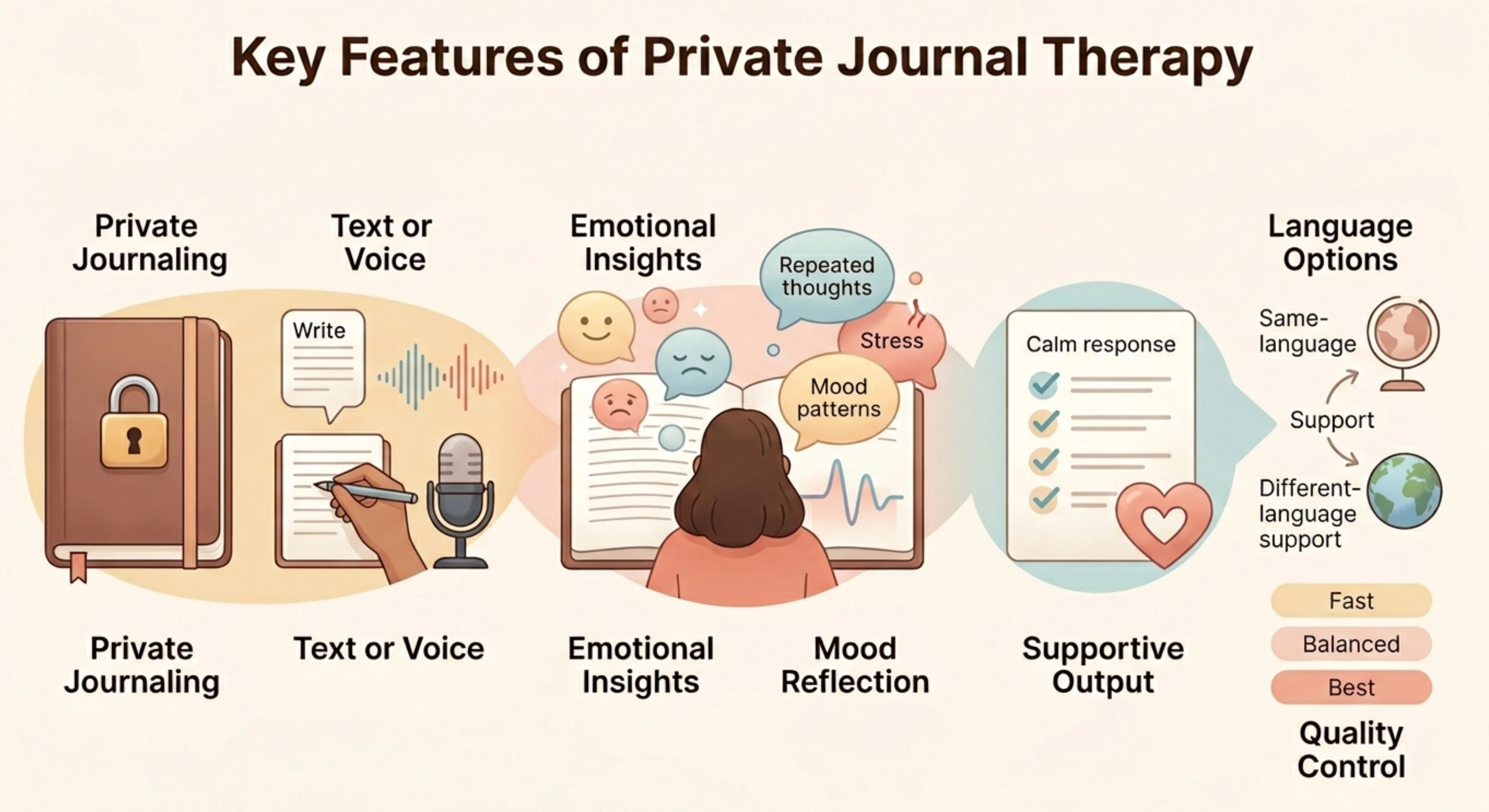
Key features of Private Journal Therapy
Secure private journaling
The tool is designed for private emotional expression, so users can write or speak openly in a safe and secure space.
Text and voice support
Users can journal through written text or voice input, depending on what feels easier and more natural.
Emotional insight generation
The tool helps identify emotions from your input and explains them in a clearer form, so you can better understand what you may be feeling.
Mood and thought reflection
Private Journal Therapy can highlight mood signals, repeated thoughts, stress points, emotional patterns, and possible areas of concern based on your journal entry.
Supportive and calm output
The response is written in a gentle and supportive way. It helps you reflect without making you feel judged or overwhelmed.
Same language output by default
The output is generated in the same language as your input by default, so your emotions and personal meaning stay natural.
Choose another output language
You can also select a different output language if you want your emotional reflection in another language.
Quality control options
You can choose how deeply the tool should prepare the response based on your time, mood, and purpose.
Choose the right processing mode
Fast
Best for quick emotional reflection when you want a simple and fast overview of your journal entry.
Balanced
Best for regular journaling. It gives a good balance of speed and quality, making it useful for daily or weekly reflection.
Best
Best for deeper emotional reflection. This mode may take more time, but the response is more focused, detailed, and carefully prepared.
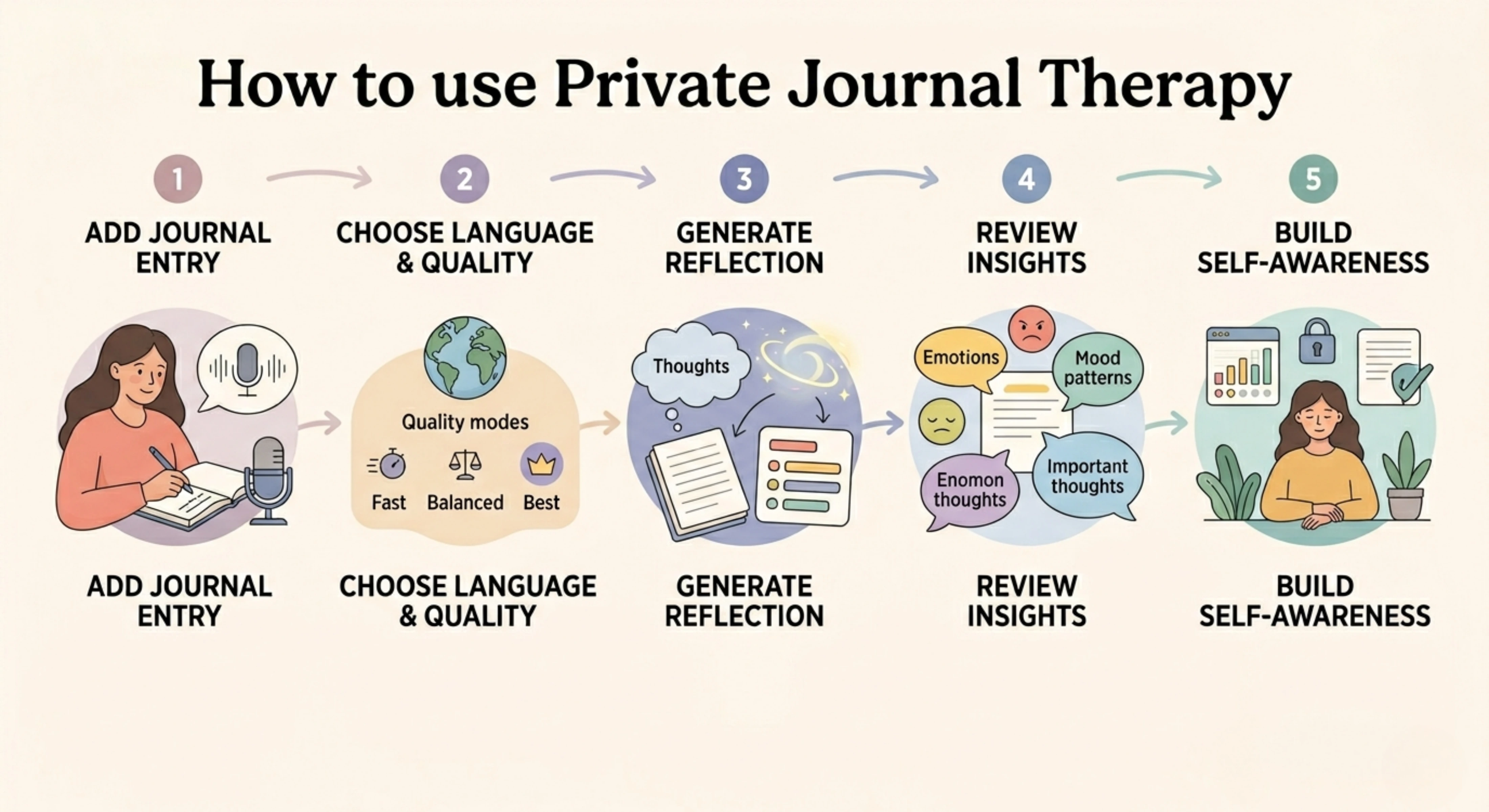
How to use Private Journal Therapy
Step 1: Add your journal entry
Write your thoughts directly or use voice input to express what is on your mind.
Step 2: Choose language and quality
Keep the same output language or select another language. Then choose Fast, Balanced, or Best mode.
Step 3: Generate your emotional reflection
Let the tool analyze your journal input and turn it into a clear emotional reflection.
Step 4: Review your insights
Read the response carefully and notice the emotions, patterns, or thoughts that feel important.
Step 5: Use it for self-awareness
Use the reflection to understand yourself better, track your mood, prepare for therapy, or decide what you may need to do next.
Why use Private Journal Therapy?
Private journaling can help you express feelings that are difficult to say out loud. Many people carry stress, sadness, confusion, fear, anger, or emotional pressure without fully understanding what they are feeling.
Private Journal Therapy helps you slow down and look at your thoughts more clearly. It can turn a messy journal entry into a more organized emotional view, which makes it easier to understand your mood and inner state.
The tool is helpful when you want to process a difficult day, release emotional pressure, understand repeated thoughts, or build a habit of self-reflection. It is not a medical diagnosis tool, but it can support emotional awareness and help you recognize when you may need more support.
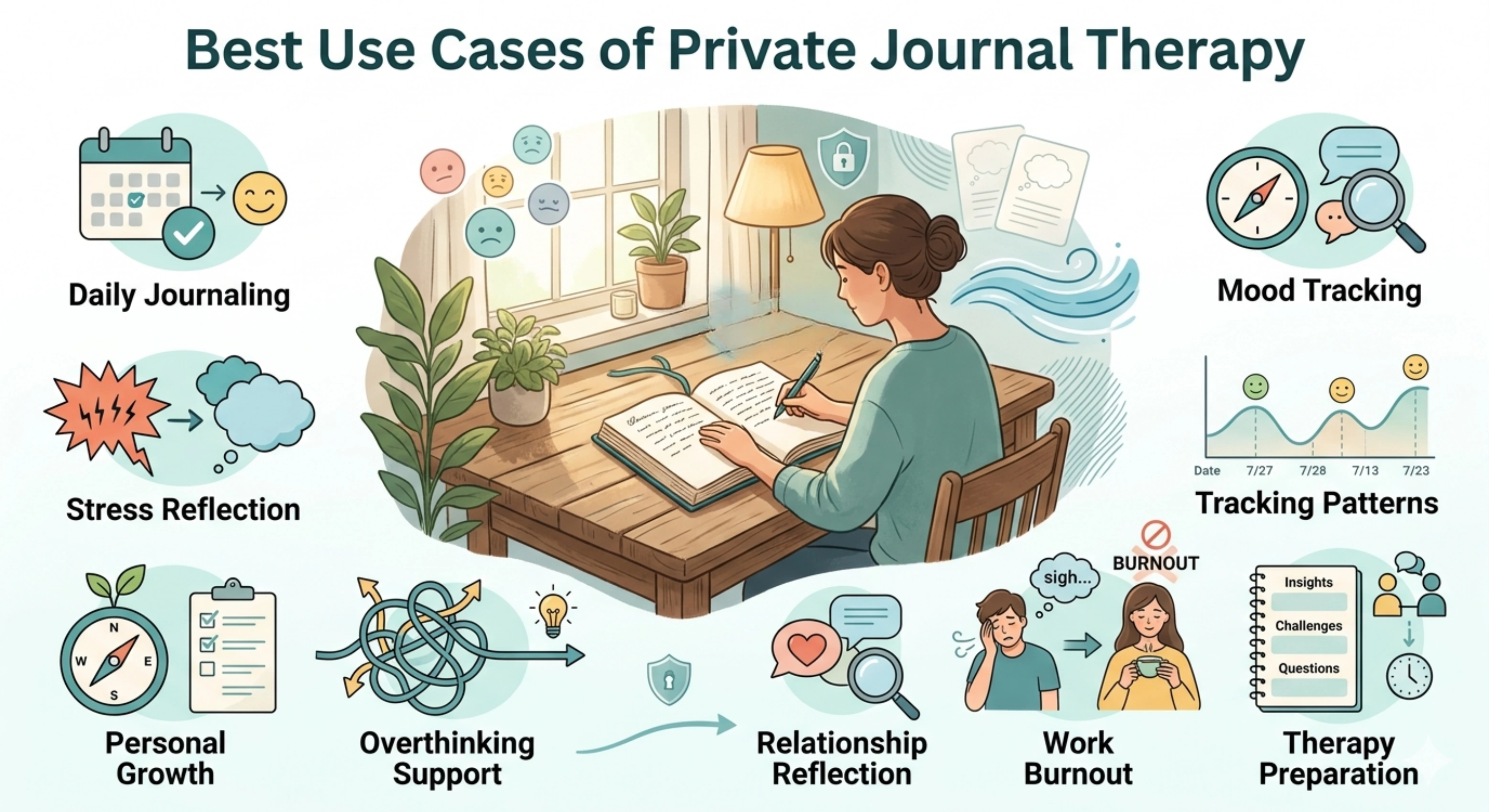
Best use cases
Daily journaling
Write or speak about your day and receive emotional insights that help you understand your mood.
Stress reflection
Use the tool to process stressful thoughts and understand what may be affecting your peace of mind.
Overthinking support
Express repeated worries, racing thoughts, or emotional pressure and turn them into a clearer reflection.
Mood tracking
Use journal entries to notice emotional patterns over time and understand what affects your mood.
Personal growth
Reflect on your behavior, goals, emotional triggers, reactions, and inner thoughts in a more structured way.
Relationship reflection
Write about communication issues, conflicts, emotional distance, or relationship stress and receive a clearer emotional overview.
Work and burnout reflection
Use the tool to reflect on workplace stress, tiredness, frustration, or pressure and understand how it may be affecting you.
Therapy preparation
Organize your thoughts before speaking with a therapist, counselor, coach, or trusted person.
Emotional journaling for self-awareness
Private Journal Therapy helps you understand your thoughts by turning them into clearer emotional meaning. When you write or speak your feelings, they become easier to notice and process.
The tool supports this process by identifying emotional signals and presenting them in a calm, readable way. This can help you understand what you are feeling and why certain thoughts may keep coming back.
Voice journaling for natural expression
Some feelings are easier to speak than write. Voice journaling allows you to express your mind in a more natural way. This is helpful when you feel overwhelmed, tired, emotional, or unable to write long entries.
You can speak freely, and the tool will help turn your voice input into emotional reflection.
Secure space for private reflection
Private Journal Therapy is designed for people who want a safe space to reflect. Users can express personal thoughts, emotional struggles, worries, and private feelings without worrying about judgment.
This makes the tool useful for quiet reflection, personal growth, stress release, and emotional clarity.
Understanding emotions in a clearer form
Many people know they feel something, but they cannot always name it. You may feel upset, but the real emotion could be fear, disappointment, pressure, loneliness, guilt, or frustration.
Private Journal Therapy helps make emotions easier to understand by reading your input and reflecting possible feelings in a clearer way. This can help you connect your thoughts with your emotional state.
A helpful tool for difficult days
Some days feel too full. You may not want advice, but you still need somewhere to put your thoughts. Private Journal Therapy gives you a space to express what happened, how it affected you, and what emotions may be sitting underneath the surface.
It can help you slow down, reflect, and understand your inner state before reacting, making decisions, or carrying the emotions into the next day.
Tips for better journal therapy results
Write or speak honestly about what you are feeling.
Add context about what happened and why it matters to you.
Mention any repeated thoughts, worries, or emotions you have noticed.
Use Best mode when you want a deeper and more complete reflection.
Read the output slowly and notice which parts feel true or helpful.
Use the tool regularly if you want to track mood and emotional patterns.
Speak to a professional if your emotions feel too heavy, unsafe, or difficult to manage alone.
FAQs
Does journaling actually help when you feel mentally tired?
Yes, it can help. Writing your thoughts down gives your mind some space. It does not remove the problem instantly, but it can make the pressure feel more manageable.
What should I write when I do not know what I am feeling?
Start with whatever feels true, even if it is unclear. You can write things like “I feel off today,” “I feel heavy,” or “I do not know why I am upset.” You do not need to understand the emotion before writing. Sometimes the writing helps you find it.
Is AI journaling private enough for personal thoughts?
Privacy is one of the biggest concerns with any journal therapy or AI journaling tool. A private journal tool should be designed for secure writing, especially when users are sharing emotional thoughts, relationship issues, stress, or personal experiences. Still, users should always be careful with very sensitive details and use tools that clearly respect privacy.
Can an AI journal replace therapy?
No. An AI journal can help you reflect, organize your thoughts, and understand your emotions better. But it cannot replace a licensed therapist, doctor, or mental health professional.
Why do people use AI journals instead of a normal diary?
A normal diary gives you a place to write. An AI journal can also help you understand what you wrote. It may point out emotions, repeated thoughts, mood patterns, or questions you may want to think about more deeply.
Is voice journaling useful for emotional release?
Yes. For many people, speaking feels more natural than typing. Voice journaling can be helpful when emotions feel too strong, when you are tired, or when you just want to say everything without worrying about sentence structure.
How often should I use a private journal?
There is no fixed rule. Some people journal every day, while others only use it when they feel stressed, confused, or emotionally full. Even a few honest entries in a week can help you notice patterns.
Next in the studio
Related tools
Next steps in the Speak → Craft → Hear studio — each card shows why it fits.