How to Generate Best Ad Hooks for Social Media Ads | Simple Way
Most ads die in the first second. Not because the product is bad. Not because the targeting is off. Because the first line did nothing.
People scroll fast. If your opening line doesn't stop them, they're gone before you even get to your offer. That one line, your hook, is the whole game.
This guide breaks down exactly how to write hooks that actually work, with real examples, a simple formula you can use right now, and a faster way to generate them when you're short on time.
What Makes a High-Converting Ad Hook?
A hook does one job: make someone stop scrolling long enough to care. It's not about being clever or creative. It's about hitting something real, fast.
The best hooks do these things:
Stop attention the moment someone sees it
Create a curiosity gap that pulls them in
Speak directly to a specific pain, fear, or desire
Feel personal, like it was written for them
If your hook is missing even one of these, the rest of your ad won't matter.
Types of Well-working Ad Hooks
Curiosity Hooks
These work by leaving something open. The reader has to keep going to get the answer.
"This one line doubled my conversion rate."
"Nobody talks about this part of running Facebook ads."
"We removed this from our ad and sales went up."
"There's a reason your hooks keep failing. It's not what you think."
"We tested 40 hooks. Only 3 actually worked."
Problem–Solution Hooks
Call out the pain first. Once they feel seen, they want the fix.
"Tired of spending on ads that nobody clicks?"
"Your product is good. Your hook is killing it."
"Still writing hooks from scratch? There's a better way."
"Low reach, low clicks, same budget. Here's what's actually wrong."
Bold or Contrarian Hooks
Say something that goes against what people expect. It creates instant friction and curiosity.
"Good visuals won't save a bad hook. Period."
"Stop trying to make your ad look professional."
"More budget won't fix a weak opening line."
"Viral ads aren't creative. They're just honest."
Question Hooks
A well-placed question makes people answer it in their head. That engagement keeps them reading.
"What would you do with 3x more leads this month?"
"Why are your competitors getting all the clicks?"
"Are you starting your ads the wrong way?"
"Have you ever tested your hook before running an ad?"
Relatable Hooks
These feel like something the reader already thought or felt. Familiarity builds trust fast.
"I used to spend hours writing ads that got zero results."
"We wasted $2,000 before we figured this out."
"Posting every day with nothing to show for it? Same."
"I thought better design was the answer. It wasn't."
Simple Formula to Generate Ad Hooks on Your Own
Step 1: Identify the Pain or Desire
Who are you talking to and what do they actually want? Write it in one line before anything else. Be specific. "People who run ads" is too broad. "Small business owners burning budget on Facebook ads with no results" is the right level.
Step 2: Choose Your Hook Type
Pick from the types above based on what fits your product and audience. Selling a solution to a frustration? Use problem-solution. Launching something new? Curiosity hooks work well. Making a bold claim? Go contrarian.
Step 3: Add Tension or Curiosity
Once you have a draft, ask yourself: would I stop scrolling for this? If the answer is no, add a gap. Leave something unanswered. Make them want to know what comes next.
Step 4: Trim It Down
Shorter almost always wins. Cut every word that doesn't do work. If your hook is three lines, make it one. If it's one line, see if half of it can go.
Social Hook Generator by VoiceCraftTool
Writing scroll-stopping hooks consistently is harder than it looks. You either spend too much time thinking or end up repeating the same patterns that stop working. This is where a tool like Social Hook Generator by VoiceCraftTool comes in.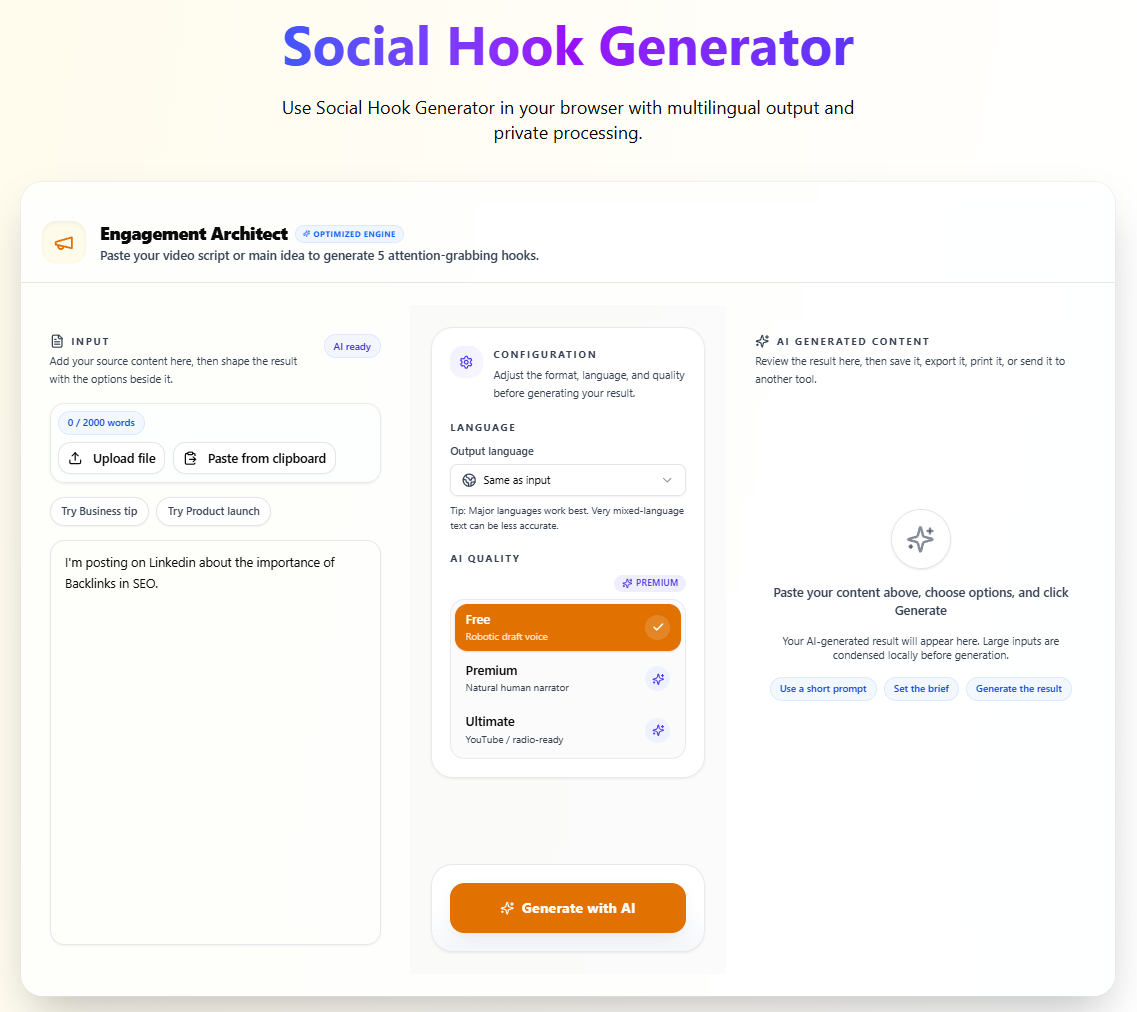
Key Features:
Instant Hook Variations
Enter a single idea and get multiple hook options at once. This helps you quickly test different angles without rewriting from zero.
Built on Proven Hook Formats
The tool uses structures that already work, curiosity, problem-solution, bold claims, and more, so your hooks are not random, they are strategic.
Platform-Focused Output
Hooks are optimized for short-form platforms like Instagram, TikTok, and Facebook where attention spans are extremely low.
Simple Input, Fast Results
You don’t need complex prompts. Just describe your idea, and the tool handles the rest in seconds.
A/B Testing Ready
Generate multiple variations easily so you can test and find which hook performs best instead of relying on one guess.
Multilingual Flexibility
You can input your idea in one language and generate hooks in another, making it easier to target different audiences without extra effort.
How to Use the Social Hook Generator (4 Simple Steps)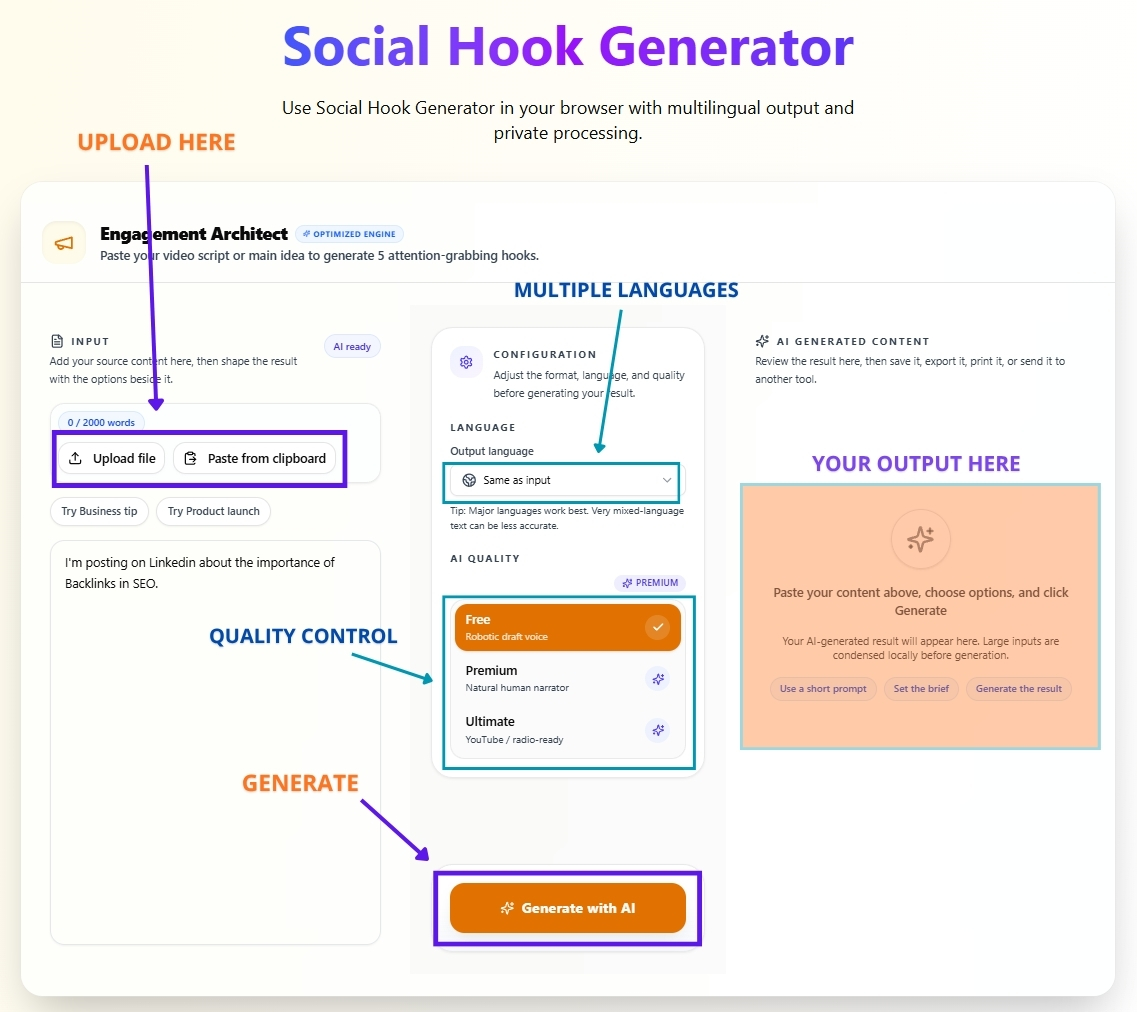
Step 1:
Enter Your Idea: Type in your ad concept, product, or message. Keep it simple, just the core idea is enough.
Step 2:
Choose a Hook Style:Pick a style like curiosity, bold, question, or problem-based if you want more targeted results.
Step 3:
Generate Hook Variations: Click generate and instantly get multiple hook options based on your input.
Step 4:
Pick, Edit & Test: Select the best hook, tweak it if needed, and use it in your ad. Test different versions to see what performs best.
Combine Your Creativity with AI Workflow
High-performing ad hooks do not come from AI alone. They come from combining your idea with AI speed and then refining the output with intent. The tool helps you generate options, but the direction and final impact still come from you.
#1 - Start with your core idea
Define what you are promoting and who it is for. Keep it clear and specific. Example Helping small businesses get more leads
#2 - Choose a clear angle
Decide how you want to present the idea. This could be a pain point, a curiosity gap, a bold claim, or a direct question. Example Struggling to get consistent leads
#3 - Generate multiple hook variations
Use the Social Hook Generator to turn your idea into different hook options. This gives you a range of approaches without spending extra time thinking of each one manually.
#4 - Refine the best option
Pick the strongest hook and improve it. Make it shorter, add a specific detail, and ensure it sounds natural and direct.
#5 - Test and learn
Use two or three variations instead of relying on a single hook. Track which one performs better and use that insight for future ads.
Simple formula to follow:
Your Idea + Emotion/Angle + AI Variations + Refinement = High-Converting Hooks
Your idea plus a clear angle plus AI generated variations plus refinement leads to stronger, high-converting hooks
Why it works:
You avoid creative blocks
You get speed without losing control
You create hooks that are both strategic and human
It removes guesswork, speeds up the process, and still keeps your content aligned with your audience. You stay in control of the message while using AI to scale your creativity.
Common Mistakes That Kill Your Ad Hooks
Starting with “we” or your brand name shifts focus away from the reader. People care about their problem, not your company.
Hooks that are two or three sentences long lose attention fast. Keep it short and direct. Vague wording weakens impact. Specific lines connect better and feel more real. No curiosity or tension means no reason to continue. Flat statements get ignored.
Trying to say everything at once overwhelms the reader. A hook should spark interest, not explain everything.
Buzzwords like “game-changing” feel empty. They reduce trust instead of building it. Writing for yourself instead of your reader breaks connection. Focus on what they feel and want.
Quick Tips to Improve
Keep it under 10 words when possible
Use a specific number instead of a general claim
Say "you" not "people" or "businesses"
Write 5 versions and then choose the best one
Read it out loud. If it sounds awkward, rewrite it
Test two hooks against each other before scaling
Conclusion
Your hook is not just the first line of your ad. It's the reason anyone reads the rest of it. A strong hook with an average offer will outperform a great offer with a weak hook every time.
Use the formulas here, write multiple versions, and test them. If you want to move faster, use the Social Hook Generator to get a strong starting point and build from there.
The first line is where the work happens. Get that right and everything else gets easier.
FAQs
What is an ad hook and why does it matter for social media ads?
An ad hook is your ad's opening line designed to stop scrollers in their tracks. Most ads fail in the first second, not because of bad products or targeting, but weak hooks. It creates curiosity, hits pain points, and feels personal, making viewers care enough to read your offer. Without it, even great ads get ignored. Example: "This one line doubled my conversion rate." Master hooks, and your click-through rates improve.
How do I write ad hooks from scratch?
Use this simple 4-step formula:
Identify the pain or desire. Example Small business owners wasting ad budget
Pick a type such as curiosity or problem-solution
Add tension by leaving a gap
Trim to under 10 words
Draft example: "Tired of ads nobody clicks?" Test it. Shorter hooks usually perform better.
What are the best types of hooks for social media ads?
Curiosity: "Nobody talks about this Facebook ads secret."
Problem-Solution: "Your hook is killing your good product."
Bold: "Good visuals will not save a bad hook."
Question: "Why are competitors stealing your clicks?"
Relatable: "I wasted $2K on zero-result ads."
Match the type to your audience. Curiosity works well for launches, while problem-focused hooks work for fixing pain points.
How long should a good ad hook be?
Aim for under 10 words, ideally 5 to 8. Long hooks lose attention quickly.
Bad example: "Are you struggling with low ad performance and wasting money?"Good example: "Ads wasting your budget?"
If it feels long when you read it, shorten it.
How can I generate ad hooks quickly?
Combine creativity with AI. Start with your idea and angle, such as Small business lead struggles. Use the Social Hook Generator by VoiceCraftTool to get multiple variations. Refine the best ones and test them.
Simple formula: Idea + Emotion + AI + Refinement = Better hooks
How do I test which ad hooks work best?
Create 3 to 5 variations using your formula or a tool. Run A or B tests with the same ad setup. Track metrics like click-through rate, conversions, and cost per click.
Example test: "Tired of zero clicks?" vs "We tested 40 hooks. 3 worked."
Scale the one that performs best.