7 Best Online AI Therapy Tools 2026 | Private & Safe Options

Finding the right kind of mental support online is really confusing. Some tools coach, some feel like chatbots, and some are better for private reflection. This guide covers seven of the best online AI therapy tools in 2026, with a focus on privacy, safety, and what each one does best.
Features You Need
Most people searching for AI therapy tools are not in crisis. They are somewhere in the middle, feeling overwhelmed, burned out, or emotionally cluttered, and they want a way to process that without jumping straight into formal therapy.
What that usually looks like in practice:
A private space to process thoughts without worrying about who is reading them
Something that feels supportive without sounding like a wellness brochure
Help with anxiety, burnout, low mood, or just mental noise
A journaling or reflection experience that is easier than staring at a blank page
Tools that match how they naturally express themselves, whether through typing or speaking
Quick Comparison Table: 7 Best Online AI Therapy Tools in 2026
The 7 Best Online AI Therapy Tools in 2026
1. Private Journal Therapy AI by VoiceCraftTool
Best for private voice-to-journal reflection and emotional clarity
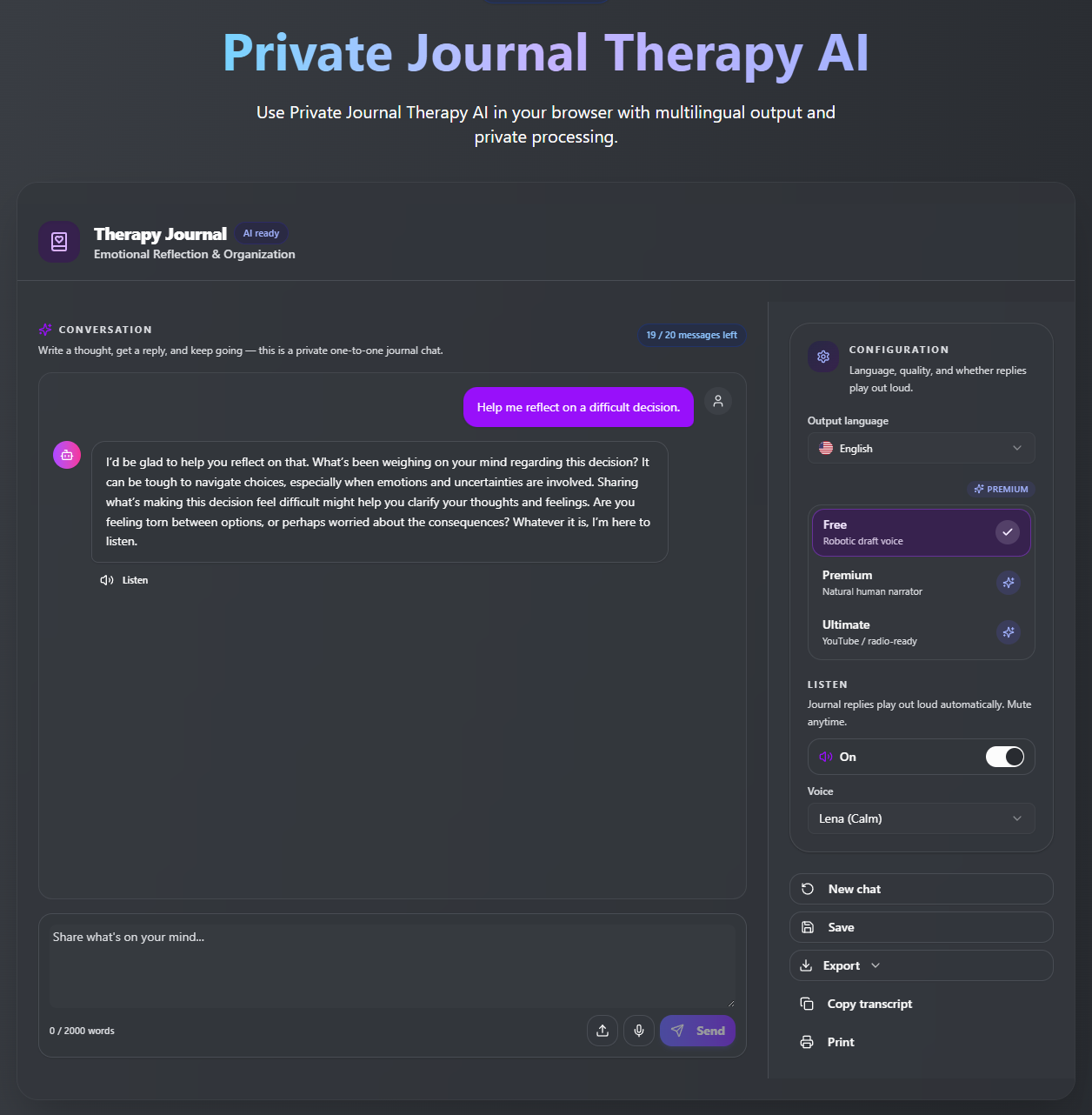
Private Journal Therapy AI by VoiceCraftTool is a reflection-first tool designed for people who process their emotions out loud. You bring in a voice note transcript or type your thoughts directly, and the tool helps you make sense of what is actually going on underneath the surface. It is not a chatbot that replies in real time.
It is more like a thoughtful mirror that reads what you said and gives back structured emotional insight.
Key Strengths
Emotional extraction: It identifies the core emotions present in your entry, not just the obvious ones, but the ones sitting underneath the words.
Theme identification: If you have been journaling for a while, it helps surface recurring patterns, which topics keep coming up, what triggers appear repeatedly.
Compassionate reflection: The tone is gentle without being generic. It does not project emotions onto you or offer clinical diagnoses.
Structured clarity: Rather than leaving you with a raw summary, it organizes your entry into reflection points you can sit with.
Voice-first workflow: This is one of the few tools that genuinely supports the transcript-to-insight pipeline, useful for people who record voice memos and want to actually do something meaningful with them.
Optional encrypted saving: You can choose to save your history privately. The default is no permanent storage, which matters for people who care deeply about where their thoughts go.
Clear safety framing: It is upfront about what it is not. It does not diagnose, does not act as a replacement for licensed care, and includes a crisis disclaimer.
Best Use Cases:
People who speak more honestly than they write
Anyone sitting on weeks of voice memos with no way to make sense of them
Daily journalers who want reflection, not just recording
Users trying to identify what is actually bothering them beneath the surface thoughts
People who want emotional support that does not feel like a back-and-forth chatbot conversation
2. Wysa
Best for structured self-therapy with optional human coaching
Wysa is an AI-powered mental wellness app that combines guided CBT-based exercises with conversational support. It has been around long enough to have a solid reputation, and it works well for people who want more than open reflection but less than a full therapy commitment.
Key Features
Cognitive behavioral therapy exercises built into daily conversations
Mood check-ins with guided coping techniques
Access to human coaches as an optional paid upgrade
Anonymous sign-up with no name or email required
Best For
People who want structure. If you are the kind of person who responds better to exercises, prompts, and guided activities than to open-ended reflection, Wysa fits well. It is also a good bridge option for people between therapy sessions who want something to practice with.
Why Choose It?
Wysa feels more like a mental wellness program than a journal. That is its strength. If you want to work through anxious thinking using actual therapeutic techniques, it delivers that in an accessible, daily-use format.
3. Woebot
Best free research-backed CBT companion
What It Is
Woebot was developed out of Stanford research and remains one of the most credible AI mental wellness tools available. It is fully free, which removes one of the biggest barriers people face when looking for support.
Key Features
Fully free with no paywall on core features
Short daily check-in conversations using CBT methods
Mood tracking with gentle pattern recognition
Built on peer-reviewed research frameworks
Best For
People who are new to this kind of tool and want something trustworthy and free. It is well suited for mild to moderate anxiety or low mood where daily support helps but the commitment of paid therapy feels like too much right now.
Why Choose It?
The research backing matters to a lot of users who are skeptical of wellness apps. Woebot has that credibility, and because there is no cost involved, the barrier to starting is genuinely low.
4. Youper
Best for emotional awareness and long-term pattern tracking
Youper blends AI conversation with journaling and mood tracking. It is built around the idea that understanding your emotional patterns over time leads to better self-awareness and fewer reactive moments.
Key Features
Mood tracking with emotional trend reports
Short conversational check-ins that adapt based on how you are feeling
Journal prompts that go beyond surface questions
Personalized emotional insight based on your history
Best For
People who want to understand themselves better over weeks and months, not just in a single session. Youper works well for anxiety and overwhelm when the goal is pattern recognition rather than immediate coping.
Why Choose It
If you have ever wanted to look back and understand why certain weeks are harder than others, Youper is built for that. It connects the dots between mood, situations, and recurring emotional states in a way most tools do not.
5. Noah AI
Best for instant voice therapy and quick support during distress
Noah AI is a voice-first mental wellness tool focused on real-time support. When something happens and you need help grounding yourself immediately, Noah is designed for that moment.
Key Features
Real-time voice conversations with an AI support companion
Grounding techniques and reframing exercises delivered through spoken interaction
Short session format suited for high-stress moments
Minimal friction to start a session
Best For
People who need support right now rather than at the end of the day. Noah is less about building long-term habits and more about having somewhere to turn when you are in the middle of a hard moment and need spoken support fast.
Why Choose It
Not everyone can write or type when they are distressed. Speaking feels more natural in those moments, and Noah is one of the few tools that actually meets people there without asking them to fill out a mood log first.
6. Wellness AI
Best all-in-one option for therapy-style chats and personalized meditation
Wellness AI combines two things most people want separately: emotional support conversations and meditation or relaxation tools. Instead of switching between apps, it brings both into one experience.
Key Features
Therapy-style chat with an AI that adapts to your emotional state
Personalized guided meditation based on what you are dealing with
Voice and text support depending on what you prefer
Ongoing check-ins that build a picture of your wellbeing over time
Best For
Users who want emotional support and a way to wind down in the same place. It works well for people whose anxiety or stress also shows up physically, through sleep problems, tension, or difficulty relaxing.
Why Choose It
The combination is genuinely useful. Talking through something emotionally difficult and then having access to a calming practice afterward, without opening a different app, suits people who want a more complete experience in one place.
7. Ash by Wellness AI
Best free-focused voice-first AI therapy option
Ash is a voice-first offshoot of the Wellness AI experience, designed to make early emotional support as accessible as possible. The focus is on removing friction entirely so that someone who has never tried anything like this before can start without hesitation.
Key Features
Voice-first interaction from the start
Core features available free without a subscription
Low barrier onboarding with no lengthy setup
Designed for private, early-stage emotional exploration
Best For
People who are curious about AI emotional support but have not committed to any tool yet. It is also well suited for users who find typing about feelings emotionally unnatural and would rather just talk.
Why Choose It
Ash is the easiest starting point on this list. If someone has been sitting on the idea of trying one of these tools but keeps putting it off, Ash is the one most likely to actually get used because the friction of getting started is almost zero.
Which Type of AI Therapy Tool Is Best for You?
It depends on how you like to process things.
If you want to turn messy voice notes or journal entries into clearer emotional reflection, Private Journal Therapy AI by VoiceCraftTool is a strong fit.
If you prefer more structure and guided CBT-style support, Wysa is the better choice. For research-backed and regular emotional check-ins, Woebot stands out. Youper suits the goal to understand mood and anxiety patterns over time .
If speaking feels easier than typing and you want quick support in hard moments, Noah AI is a natural fit. Want emotional support and meditation in one place, Wellness AI works well. And if you want a simple voice-first tool that feels easy to start with, Ash can be an option but offers not too much. You can try simplicity and prominent features together in VoiceCraftTool’s Private therapy AI.
Conclusion
There is no single best AI therapy tool for everyone. The right choice depends on how you process your thoughts, what kind of support you want, and how important privacy is to you.
Each tool in this guide has its own strength. For people who want calm, organized reflection from messy voice or text entries, Private Journal Therapy AI by VoiceCraftTool is a particularly strong fit.
FAQs
What are the best online AI therapy tools in 2026?
This is one of the clearest intent-matching FAQs because users searching this topic usually want a shortlist they can compare by privacy, support style, voice or text use, and cost. “Best of” comparisons dominate this category.
Are AI therapy tools actually safe to use?
Safety is one of the biggest public concerns. People want to know whether these tools give responsible emotional support, how they handle crisis situations, and where their limits are. Recent reporting and expert commentary repeatedly warn that AI should not be treated as a full therapy substitute, especially in serious mental health situations.
Can AI therapy tools replace a real therapist?
This is a very common question and should absolutely be addressed. It appears often because many users are curious about whether AI is just a support tool or something they can rely on instead of human care. Most expert sources say AI may help with reflection, coping support, or between-session support, but it should not replace licensed therapy in higher-risk cases.
Which AI therapy tool is best for privacy?
Privacy is one of the most repeated discussion points in public forums and mental-health AI content. Users want to know whether entries are stored, whether saving is optional, whether data is encrypted, and whether their conversations are used for training.
Is it better to use a voice-based AI therapy tool or a text-based one?
This is a strong FAQ because different tools now support very different experiences. Some emphasize real-time voice support, while others are more journaling- or chat-based. Users often want help choosing based on how they naturally express emotions.
Are there any free AI therapy tools that are actually worth trying?
Price is a common filter in this category. Many users want a free starting point before they commit to a subscription, and public comparisons often highlight which tools have a real free tier versus limited trials.
Which AI therapy tool is best for anxiety, stress, or burnout?
Users rarely search just for “AI therapy.” They often search with a problem in mind. Anxiety, stress, low mood, and burnout are common situations people want help with, so this FAQ aligns well with real user behavior.
Can AI therapy tools help with journaling and emotional reflection?
This is especially relevant for your article because many users are not looking for therapy replacement. They want help processing thoughts, spotting patterns, or making sense of emotional entries. Several tools in this category position themselves around reflection, journaling, or pattern tracking rather than treatment.