AI Therapy Notes Free Tool 2026 | Private & Simple Use Guide
Sep 10, 2026
12 min read
Sometimes the hardest part is finding the right words for what you feel. AI therapy notes tools help make that easier by turning thoughts, emotions, and reflections into clearer notes. This guide explains what AI therapy notes are, what makes a good tool, and how Private Journal Therapy AI by VoiceCraftTool can support simple daily reflection.
What Makes a Good AI Therapy Notes Tool
Before looking at any specific tool, it helps to know what actually matters for this kind of use. Here is what to look for.
Private to use - Your reflections are personal. A good tool should not make you worry about who can see what you write.
Easy to start - There should be no complicated setup or technical steps before you can begin.
Helps organize thoughts clearly - The output should feel like your thoughts, just more structured. Not something generic or disconnected.
Works well for voice and text input - Some people think better by speaking. Others prefer typing. A flexible tool works for both.
Useful even for beginners - You should not need any experience with journaling or AI tools to get something useful out of it.
Private Journal Therapy AI by VoiceCraftTool
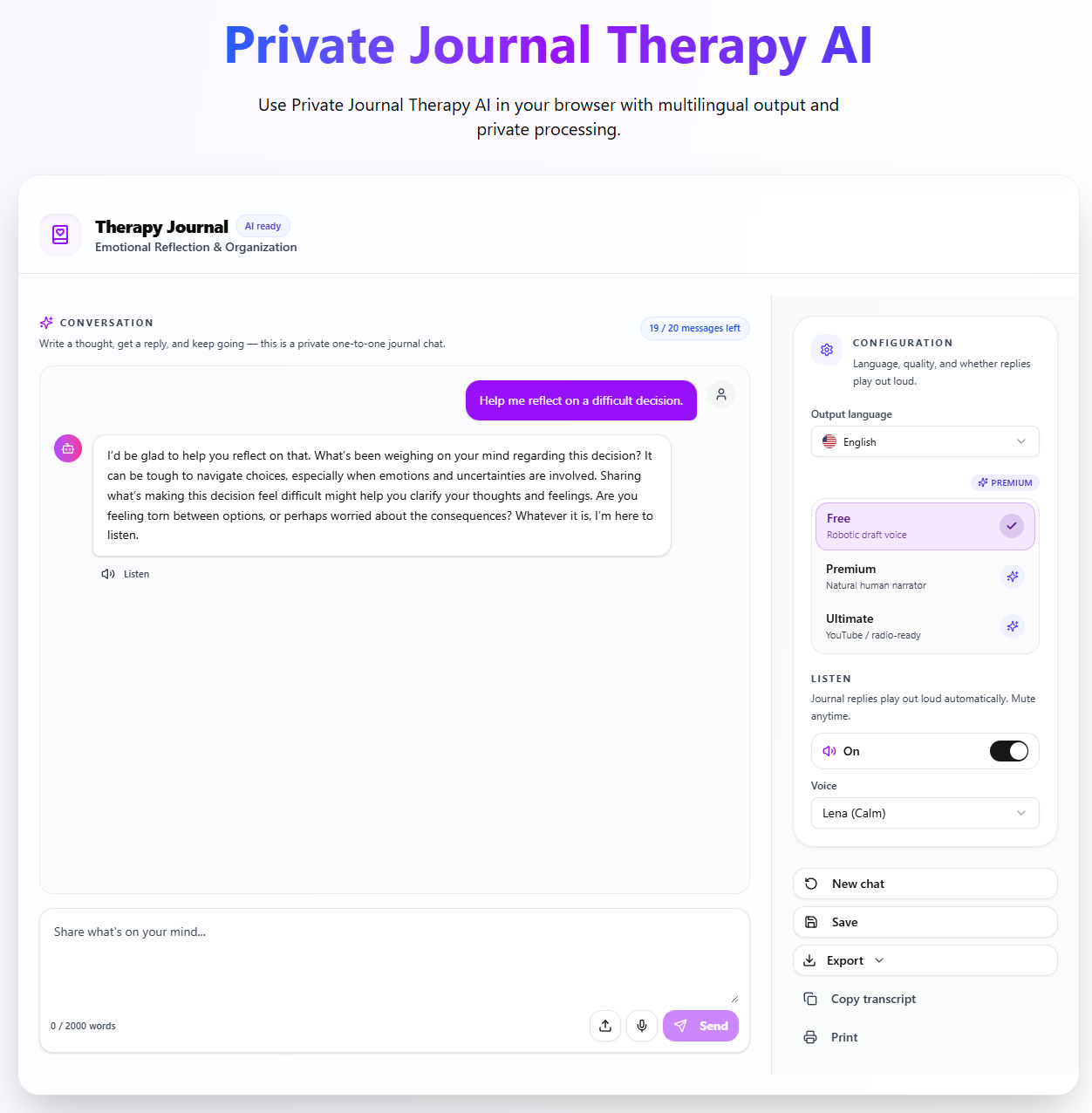
Private Journal Therapy AI by VoiceCraftTool is a tool built for people who want a simple, private space to reflect and turn their thoughts into clearer notes. It is not designed to replicate clinical therapy. It is designed to make the process of personal reflection easier and more accessible.
If you have ever felt like your thoughts are scattered and you just need help organizing them into something readable, this is the kind of tool built for that specific moment.
Best suited for:
Personal journaling and daily reflection
Working through emotions after stressful experiences
Turning spoken thoughts into written notes
Building a simple, consistent self-reflection habit
Some people process thoughts better by speaking, while others prefer typing. Supporting both voice and text makes journaling feel more natural and easier to start.
Private and Low-Pressure Note Creation
When you are writing about personal feelings, the last thing you want is to feel exposed or judged. The tool is designed to feel like a private space where you can be honest without filtering yourself. That low-pressure environment matters more than most people realize.
Simple Structure for Reflection Notes
One of the most valuable things an AI tool can do is take your scattered input and return something with a clear shape. Instead of a jumble of half-finished thoughts, you get a note that actually makes sense to read back later. This structure helps you understand your own patterns over time.
Free Access for Easy Trying
Committing to a paid tool before knowing if it works for you is unnecessary. Free access means you can test whether the tool fits your journaling style before making any decisions. That matters for beginners especially.
Multilingual Support
VoiceCraftTool supports multiple languages for both input and output. A user can even input in one and output in another language.
Beginner-Friendly Use
There is nothing to configure or learn before you can start. You open the tool, share your thoughts, and it does the organizing. That simplicity is the point.
How to Use the Tool for AI Therapy Notes
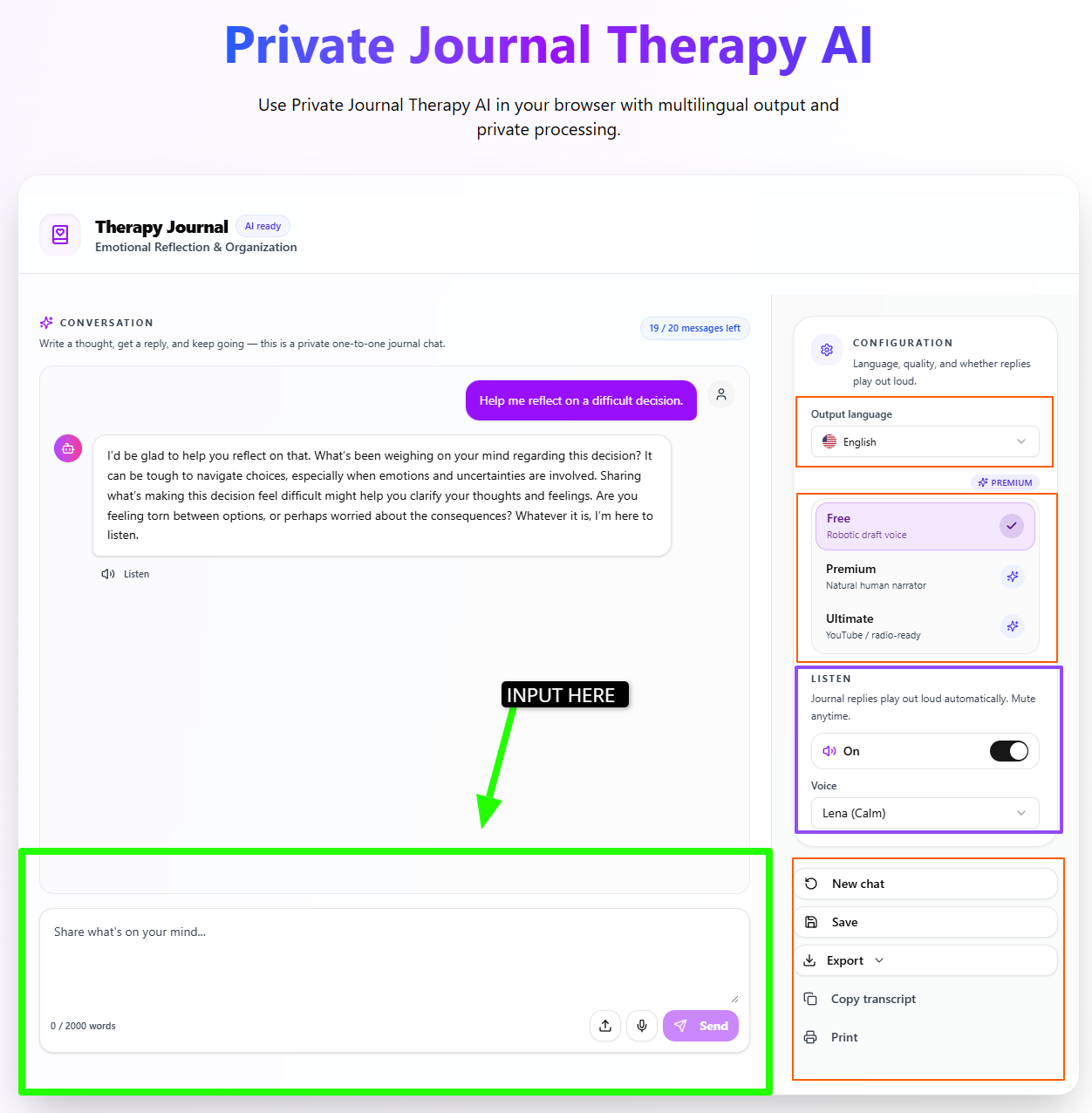
Step 1: Open the tool and choose voice or text
Decide whether you want to speak your thoughts or type them. Neither is better. Use whatever feels easier right now.
Step 2: Share your thoughts, feelings, or daily experience
You do not need to be articulate or polished. Just say or write what is on your mind. The messier the better, honestly. The AI works with raw input, not perfect prose.
Step 3: Let the AI organize it into a clearer note
Once you have shared your thoughts, the tool structures them into a readable reflection note. This is not the AI rewriting your experience. It is helping you see it more clearly.
Step 4: Review, reflect, and keep what feels useful
Read through the output. Take what resonates and leave what does not. The final reflection belongs to you. The AI is just helping you get there faster.
Ways to Use AI Therapy Notes in Everyday Life (Use Cases)
Daily emotional check-ins
A quick five-minute check-in at the end of the day can help you stay aware of how you are actually feeling, not just how busy you were. Many people find that consistency here builds over time into a genuinely useful self-awareness habit.
Stressful day reflections
After a rough meeting, a difficult conversation, or just one of those days that leaves you drained, writing through it helps close the loop mentally. It is much easier to let go of something once you have actually processed it.
End-of-week self-review
Looking back at the week through a short reflection note gives you a clearer picture of what drained you, what went well, and what you want to carry forward. It takes ten minutes and is often more useful than it sounds.
Mood and thought tracking
Over time, your notes become a record of patterns. You start to notice what kinds of situations consistently affect your mood, which thoughts keep coming back, and where you have actually made progress.
Turning voice thoughts into journal notes
For people who think out loud, the voice-to-note feature is particularly useful. You talk through something, and instead of it disappearing into the air, you have an actual written note to return to.
What AI Therapy Notes Can Help With and What They Cannot Replace
This matters, so it is worth being clear about.
Helpful for:
Organizing and expressing personal thoughts
Building a consistent journaling or reflection habit
Noticing emotional patterns over time
Processing everyday stress and feelings
Making reflection faster and less intimidating
Not a replacement for:
Licensed therapists or mental health professionals
Clinical diagnosis or treatment
Crisis support or emergency mental health care
Ongoing professional therapeutic relationships
If you are going through something serious, please reach out to a qualified professional. A journaling tool is a support for everyday reflection. It is not equipped to handle what a trained therapist can.
Tips for Getting More Useful Reflection Notes
Be honest rather than polished. The AI works better with real thoughts than edited ones.
Focus on one feeling or situation at a time rather than trying to cover everything at once.
Include specific details when you can. General statements give general notes back.
Read the output in your own words after. Does it actually sound like you? Adjust if not.
Keep only what feels useful. Not every note will be valuable and that is completely fine.
Common Mistakes to Avoid When Using AI for Therapy-Style Notes
Expecting it to replace therapy. It will not and should not. Use it alongside professional support if you have it, not instead of it.
Over-editing before you start. If you spend ten minutes trying to phrase your thoughts perfectly before giving them to the AI, you are defeating the purpose. Let it be messy.
Assuming every output will be perfect. Sometimes the AI organizes things in a way that does not quite capture what you meant. That is normal. Adjust it to fit.
Skipping personal reflection afterward. The note the tool creates is a starting point, not an ending point. Read it, sit with it, and think about what it means to you.
Ignoring privacy settings on any tool you use. Before sharing personal thoughts anywhere, check the privacy approach of the tool. This applies here and everywhere.
Why People Use AI for Personal Reflection and Journaling
People come to tools like this from very different places. But the reasons tend to follow a few common patterns.
When your thoughts feel messy
Some days your mind is running in ten directions and none of it makes sense yet. Sitting down to journal feels impossible because there is no logical starting point. An AI tool gives you a structure to pour thoughts into without needing them to be organized first.
When journaling feels hard to start
The blank page problem is real. Many people want to journal consistently but freeze up when they actually sit down to do it. Having an AI prompt or guide the process removes that pressure entirely.
When you want a more private writing flow
Not everyone wants to talk to someone about what they are going through. Sometimes you just want a private space to work through something on your own terms.
When you need quick emotional clarity
After a difficult conversation, a stressful day, or a confusing situation, sometimes you just need to get your thoughts out fast and make sense of them. AI tools make that faster without requiring you to write a perfect entry.
Who This Tool Is Best For
People who already journal but want a more structured approach
People who have always wanted to journal but never knew where to start
Anyone who processes thoughts better by speaking than typing
Users looking for a free way to try AI-assisted reflection before committing to anything
Anyone wanting a simple, private space to work through daily thoughts and emotions
If you identify with any of those, the tool is likely worth a try.
Is a Free AI Therapy Notes Tool Worth Trying?
For most people, yes. If you are curious about whether AI-assisted journaling works for you, trying it for free is the obvious first step. You will know within a few sessions whether it fits how you think and what you need from a reflection tool.
The value of a free tool like this is not just cost. It is the low commitment. You can explore it on your own terms, at your own pace, without any pressure. That is exactly the kind of entry point that makes a new habit easier to actually start.
Give it a try and explore the amazing useful features with AI Private Journal Therapy,
Conclusion
AI therapy notes are not a complicated concept. They are a simple way to get your thoughts out of your head and into a form that is easier to understand and return to. Private Journal Therapy AI by VoiceCraftTool is built around that exact idea: private, simple, and low-friction reflection support.
It will not replace professional therapy, and it does not try to. What it does well is make personal reflection more accessible for people who need a little help getting started. If that sounds like something useful to you, it is worth trying.
FAQs
What are AI therapy notes?
AI therapy notes are AI-assisted reflection notes that help turn thoughts, emotions, and daily experiences into a clearer written format. For most users, this means personal journaling and self-reflection support rather than formal clinical documentation.
Can AI help me write therapy-style notes from my thoughts or feelings?
Yes. AI can help organize scattered thoughts, emotions, and experiences into a more structured note that is easier to read back later. This is especially useful for people who know how they feel but struggle to put it into words.
Is an AI therapy notes tool private to use?
Privacy depends on the tool. Before using any AI reflection or journaling tool, users should check how their data is handled, whether content is stored, and what privacy controls are offered. Privacy is one of the biggest concerns people raise when using AI for personal reflection.
Can AI therapy notes replace a real therapist?
No. AI therapy notes tools can support journaling, emotional reflection, and thought organization, but they are not a replacement for licensed therapy, diagnosis, or crisis support. They work best as a personal reflection aid, not as professional mental health care.
Is there a free AI therapy notes tool I can try first?
Yes. Many users specifically look for free AI therapy notes tools so they can test whether AI-assisted journaling fits their routine before paying for anything. A free option is often the easiest starting point for beginners.
Can I speak my thoughts instead of typing them?
In many cases, yes. Some AI journaling and therapy-style note tools support voice input as well as text, which helps people who find it easier to talk through their feelings instead of writing everything manually.
How do AI therapy notes help with journaling or self-reflection?
They help reduce blank-page pressure by giving shape to messy thoughts. Instead of trying to write a perfect journal entry from scratch, users can share what is on their mind and let the tool organize it into something more readable and useful for reflection.
What is the difference between an AI journal tool and an AI therapist?
An AI journal tool helps you capture, organize, and reflect on your own thoughts. An AI therapist is usually presented more like a conversational support system. Even then, AI systems are still not a substitute for licensed mental health professionals when real therapy or clinical support is needed.
Did you find this helpful?
Share this article with your friends and colleagues.