How to Analyze Sales Call Effectiveness Across Industries
Sep 9, 2026
11 min read
Most sales teams record their calls, but far fewer know how to judge whether those calls were actually effective. Listening to a call is one thing. Understanding whether it moved the sale forward is another.
That gets harder when different industries require different standards. A strong SaaS call may not look like a strong real estate or healthcare call. This guide explains what to measure, how to review sales calls properly, how standards change across industries, and how AI can make the process easier.
What Makes a Sales Call Effective?
Many teams judge sales calls too narrowly. If the call ends in a sale, they call it effective. If it does not, they treat it as a weak call. That leaves out many important signs of progress.
A sales call can still be effective without an immediate close. In many cases, the goal is to move the buyer forward in the right way based on the stage of the conversation.
Factors that make a sales call Effective:
clear understanding of the buyer’s needs
strong discovery questions
relevant pain points identified
trust and rapport built during the conversation
objections handled with clarity
value explained in a way the buyer understands
the right decision-maker involved when needed
clear next steps agreed before the call ends
progress made for that stage of the sales process
A better way to judge effectiveness is this: did the call achieve the right purpose for that stage of the sale? That is a much more useful standard than looking at closed deals alone.
How Sales Call Analysis is different across Industries
The same call review standard does not work for every industry. A strong sales call in one field may not look the same in another.
Sales cycles differ
Some industries close faster, while others take longer and involve more stages. That changes what a productive call looks like.
Compliance requirements vary
In fields like healthcare and finance, calls may need specific disclosures, approvals, or consent. A smooth call is not enough if those points are missed.
Buyer urgency changes
Some buyers are solving urgent problems, while others are still exploring options. This affects tone, pace, and what counts as progress.
Trust matters at different levels
In industries involving high budgets, sensitive data, or major decisions, trust-building becomes a bigger part of call quality.
Pricing models shape the conversation
A subscription sale, one-time service, or commission-based deal each requires a different kind of discussion. That changes what you should evaluate in the call.
AI Sales Call Analyzer by VoiceCraftTool Helps With Sales Call Analysis across Industries
Reviewing sales calls across industries is not just about replaying recordings. The real challenge is turning conversations into something clear enough to evaluate, especially when buyer needs, sales cycles, and expectations vary.
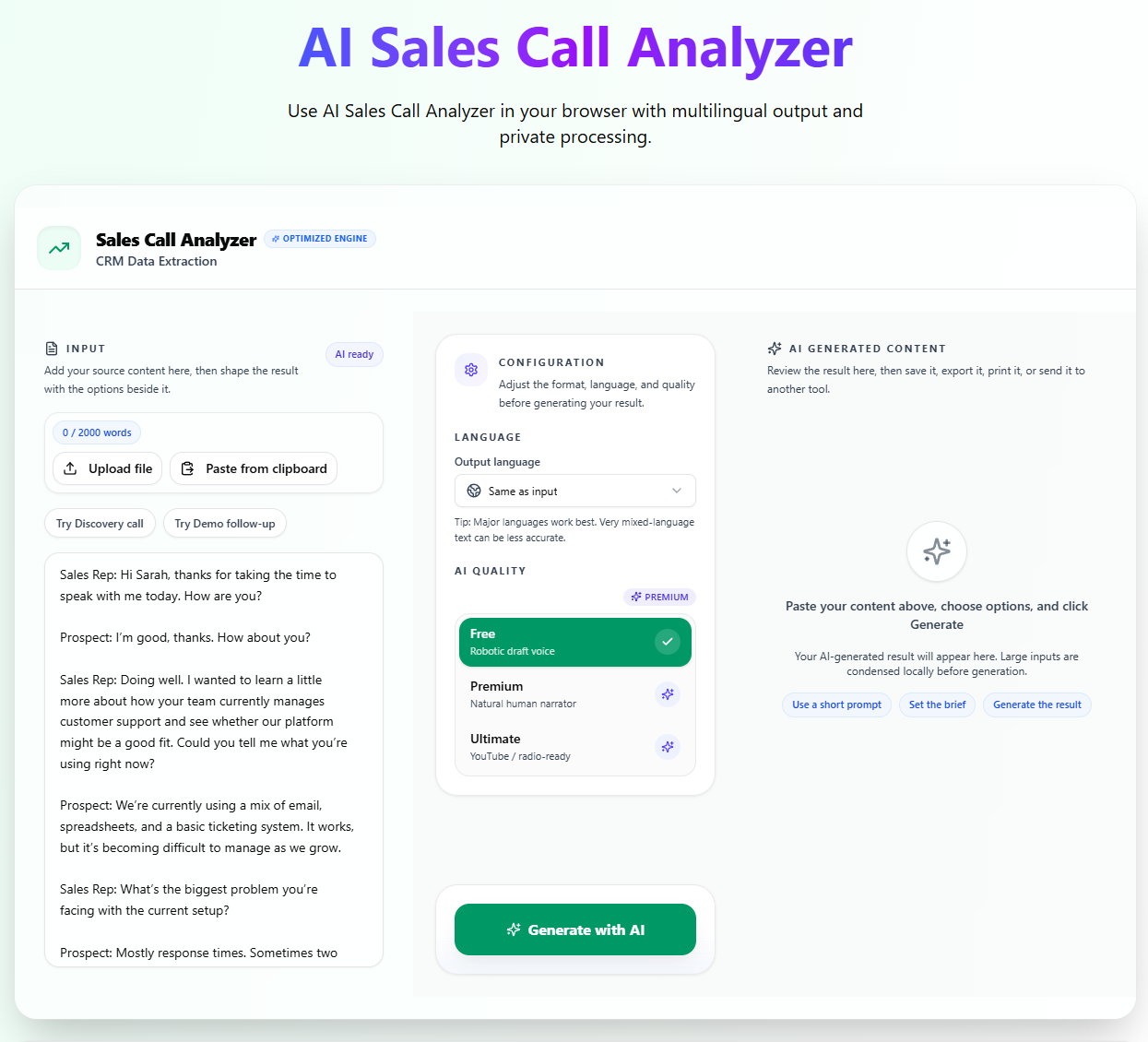
AI Sales Call Analyzer by VoiceCraftTool helps by turning sales transcripts into structured notes that are easier to review, compare, and use in follow-up. This makes sales call analysis more manageable and helps teams judge whether a call actually moved the opportunity forward.
Key Features:
Structured CRM-style output
The tool turns sales conversations into organized CRM-ready notes that teams can review and use more easily.
Budget and timeline extraction
It identifies mentions of budget, pricing concerns, and timing so teams can better understand urgency and deal readiness.
Next-step identification
It pulls out follow-ups and agreed action points, making it easier to see whether the conversation created real progress.
BANT and MEDDIC-aware review
The tool is designed to detect BANT and MEDDIC-style signals in the conversation, even when they are not stated in a perfectly direct way.
Simple transcript-based workflow
Users can paste a Zoom or Teams transcript, review the generated result, and use the structured output for sales notes or opportunity tracking.
Useful across more than one call type
While it is especially suited for B2B discovery calls, it can also help with other business conversations where structured review is useful.
Multilingual Support:
It supports multiple languages, even the input and output can be in different languages. You can input in one and get output in some other language.
How VoiceCraftTool fits for sales call analysis across industries:
For an article about analyzing sales call effectiveness across industries, this tool works best as a practical support layer. It helps organize conversations into reviewable points so teams can apply their own industry standards with more consistency. That is especially useful when the meaning of an effective sales call changes from one industry to another.
Core Metrics it Analyze in Any Sales Call:
While industries differ, some metrics matter in almost every sales conversation.
Opening and first impression: Did the rep build credibility and clearly set the purpose of the call early on?
Discovery question quality: Were the questions thoughtful enough to uncover real needs, priorities, and problems?
Talk-to-listen balance: Did the buyer have enough room to speak, or did the rep control too much of the conversation?
Objection handling: Were concerns addressed clearly and in a way that kept the call moving forward?
Value communication: Did the rep explain the value in a way that matched the buyer’s actual situation?
Buyer engagement signals: Did the buyer ask questions, share context, or show real interest during the call?
Next-step commitment: Did the call end with a clear and agreed next action?
Follow-up quality: Was the follow-up timely, relevant, and helpful in keeping momentum going?
How to Use AI Sales Call Analyzer by VoiceCraftTool
Using the tool should feel simple and practical. The goal is to take a sales conversation and turn it into something easier to review, compare, and act on.
Step #1. Add the sales call transcript
Start by pasting the transcript from your sales call into the tool. This gives you a written version of the conversation that can be analyzed more clearly than raw audio alone.
Step #2. Let the tool organize the key details
Once the transcript is added, the tool pulls out the important sales information from the conversation. This can include buyer needs, possible decision-makers, budget signals, timing, and next steps.
Step #3. Review the structured output
Go through the organized results and check whether the call moved the opportunity forward. Look at what was uncovered, what was missed, and whether the conversation achieved its purpose for that stage of the sales process.
Step #4: Use the insights for follow-up and improvement
Apply the output to your CRM notes, follow-up planning, coaching, or internal review process. This helps teams make sales call analysis more consistent, especially when reviewing calls across different industries.
Do not judge every sales call by the same standard. A discovery call, a follow-up call, and a closing call each have different goals. Your analysis should match the purpose of that specific stage.
Focus on buyer movement, not just rep performance
A polished rep does not always mean an effective call. Look at how the buyer responded, what they shared, how engaged they were, and whether the conversation moved forward in a meaningful way.
Compare patterns across multiple calls
One call rarely tells the full story. Reviewing multiple calls helps you find repeated strengths, weak points, common objections, and trends that are actually worth acting on.
Adapt your analysis to the industry
What matters in one industry may not matter in the same way in another. Sales cycle length, trust requirements, urgency, and compliance expectations should shape how you review the call.
Use AI to make review more practical
Manual review is useful, but it takes time. Tools like AI Sales Call Analyzer by VoiceCraftTool can help organize transcripts, extract key details, and make it easier to review a larger number of calls with more consistency.
Include follow-up in your analysis
The quality of the follow-up matters too. A strong call can lose momentum if the next message is late, unclear, or weak. Review what happened after the call as part of the full picture.
Common mistakes to avoid
judging calls only by whether they closed
ignoring the stage of the sales process
using the same scoring method for every industry
focusing too much on rep style instead of buyer response
reviewing too few calls to find real patterns
overlooking the quality of follow-up and next steps
A Simple Sales Call Review Framework
When reviewing calls, having a short checklist prevents important factors from getting skipped. Here is a practical starting point.
Call objective: Was there a clear purpose for this call, and was it communicated to the buyer?
Discovery quality: Did the rep ask meaningful questions and listen actively to the answers?
Engagement level: Did the buyer participate in the conversation, ask questions, or share relevant information?
Objection handling: Were concerns addressed directly and constructively?
Value clarity: Did the rep connect the solution to the buyer's specific situation?
Next-step commitment: Did the call end with a clear, agreed-upon action from both sides?
Overall effectiveness: Given the stage and purpose of this call, did it accomplish what it should have?
This framework works as a starting point and can be adjusted to fit your industry or sales process.
Use Cases of Sales Call Analyzer by VoiceCraftTool
Use case
How it helps
Sales managers reviewing team performance
Helps review calls more consistently, identify coaching opportunities, and understand which conversation patterns are affecting results.
Founders involved in early-stage sales
Helps founders review buyer conversations, spot missed opportunities, and improve how they present value during calls.
Call center teams handling large call volumes
Makes large-scale call review more practical by organizing conversations into clearer insights without relying only on manual listening.
Consultants and agencies improving business development
Supports better review of sales conversations, helping refine the pitch and understand where prospects engage or hesitate.
Individual sales reps working on performance
Helps reps review their own calls and improve areas such as discovery, objection handling, and next-step setting.
Small teams and growing sales operations
Works well for both solo professionals and expanding teams that want more structure and consistency in call analysis.
Conclusion
Sales call effectiveness is not just about whether a deal is closed. It is about whether the call achieved the right purpose for that stage, in that industry, and with that buyer.
A structured review process helps teams spot what is working, improve weak areas, and analyze calls more consistently. AI Sales Call Analyzer by VoiceCraftTool supports that process by making call review clearer, faster, and easier to manage.
VoiceCraftTool provides you a lot of other tools for sales, marketing and many other purposes. Explore now, Tools by VoiceCraftTool
Did you find this helpful?
Share this article with your friends and colleagues.