How to Write Clinical Accuracy AI Notes | 2026 Complete Guide
Clinical documentation is one of the most time-consuming parts of a healthcare provider’s day. After a patient encounter, writing a detailed and accurate note often feels like a second shift, where missed details and rushed wording can lead to bigger issues later.
AI tools are changing this process by handling structure and organization, allowing clinicians to focus on their judgment. This guide explains what clinical accuracy in AI notes means, how to achieve it, and how tools like Clinical Note Maker AI by VoiceCraftTool help create faster, more reliable documentation.
What Are Clinical Accuracy AI Notes?
Clinical accuracy AI notes are documentation drafts created or structured with the help of artificial intelligence, based on input provided by a clinician during or after a patient encounter. The term "clinical accuracy" here refers to how well a note reflects the actual encounter: the symptoms reported, the findings observed, the assessment made, and the plan that follows.
An accurate AI note is not simply a grammatically correct one. It needs to be complete, medically relevant, clearly structured, and free of ambiguity. It should represent what happened in the consultation without adding assumptions or leaving out meaningful details.
What Makes a Clinical Note Accurate?
Accuracy in a clinical note comes down to a few simple things. If even one is missing, the note becomes harder to understand and use.
Complete patient details:Include basic information like patient name, visit date, and relevant history. Missing details can cause confusion later.
Clear and simple language:Avoid vague wording. Be specific so anyone reading the note understands the situation quickly.
Only relevant symptoms and findings:Add details that matter to the case. Extra or unnecessary information makes the note harder to follow.
A clear assessment:Show how the symptoms and findings connect. The assessment should reflect your clinical thinking.
A clear care plan:Mention what happens next such as medications, tests, follow-ups, or instructions for the patient.
A well-organized structure:Keep the note easy to read so important information can be found quickly.
The SOAP Method as a Standard Structure
SOAP is one of the most widely recognized frameworks for clinical documentation, and for good reason. It creates a predictable structure that supports both accuracy and readability across different providers and settings.
Subjective:
This section captures what the patient says. It includes the chief complaint, symptoms, duration, severity, and relevant history. The goal is to document the patient’s experience in clear clinical language. Direct quotes can be used if they add value.
Objective:
This section includes what the clinician observes and measures. It covers vital signs, exam findings, lab results, and imaging. It helps separate what the patient reports from what can be verified.
Assessment:
The assessment explains what the findings mean. It may include a diagnosis, possible conditions, or a clinical summary. It should clearly reflect the clinician’s reasoning.
Plan:
The plan outlines what happens next. It includes treatments, medications, referrals, follow-ups, and patient instructions. It should be clear and leave no confusion about the next steps.
Clinical Note Maker AI by VoiceCraftTool create clinically accurate notes
Clinical Note Maker AI by VoiceCraftTool helps clinicians spend less time on documentation and more time with patients. It turns spoken or typed input into a structured clinical note draft.
It improves accuracy by organizing information into clear sections, so important details are not missed. It also keeps notes consistent, making them easier to read and compare over time.
The tool does not make clinical decisions. It simply reduces the workload so clinicians can review and finalize notes properly.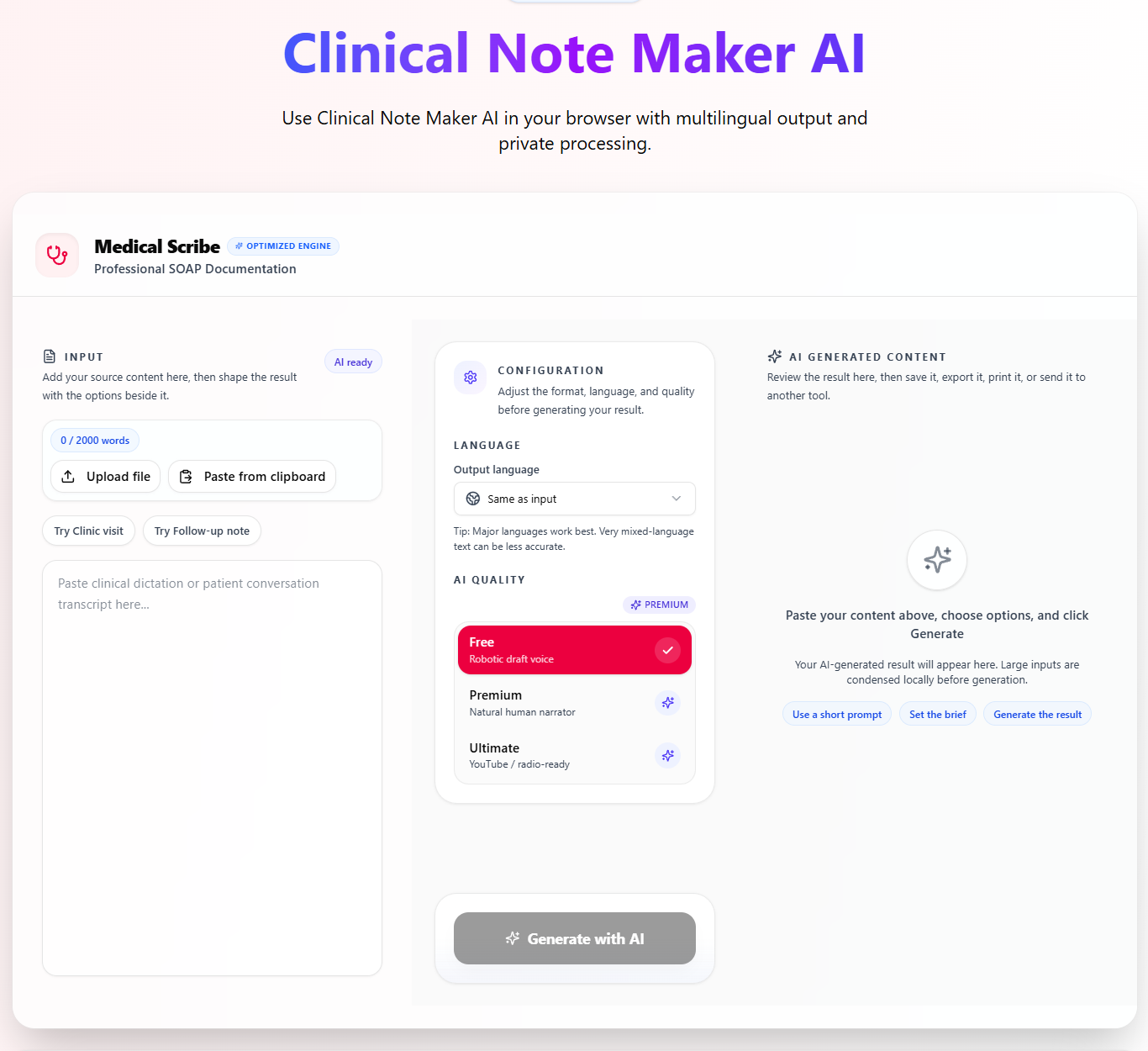
Key Features That Support Clinical Accuracy
Voice-to-Clinical-Note Conversion
Speaking naturally during or after a patient encounter often captures more complete information than typing under pressure. Clinicians can describe details in their own words without skipping key points. The tool converts this spoken input into structured text while preserving the clinical meaning.
Structured Clinical Formatting
Raw input is rarely organized. Clinicians may mention findings, symptoms, and plans in no fixed order. The tool arranges this information into the correct sections, creating a clear and logical note from the start.
SOAP-Friendly Output
The tool organizes notes into Subjective, Objective, Assessment, and Plan sections. This familiar format makes the output easy to understand and aligns with standard clinical workflows.
Clarity and Grammar Refinement
Clinical notes need to be clear without losing meaning. The tool improves grammar and sentence flow while keeping the original clinical intent unchanged.
Review-Ready Drafts
The output is a structured draft, not a final note. It is easy to review, allowing clinicians to check details, make edits, and finalize the note with confidence. Use Clinical Note Maker AI tool by VoiceCraftTool for free now and get clinically accurate clinical notes.
How to Use Clinical Note Maker AI Step by Step
Step 1: Enter or Speak Patient Details
Provide key information from the encounter, including symptoms, history, observations, test results, and plan. Speaking naturally often helps capture more complete details.
Step 2: Let the Tool Organize the Information
The tool processes the input and turns it into a structured clinical note, placing details into the right sections.
Step 3: Review for Accuracy
Check each section carefully. Make sure patient details, symptoms, assessment, and plan match the actual encounter.
Step 4: Edit and Add Missing Details
Add anything that was missed and adjust wording if needed. The final note should fully reflect your clinical judgment.
Once the note has been reviewed and edited, it is ready to be finalized. The finished note should be clear, complete, and accurate enough to stand on its own as a record of the encounter. From here, it can be saved, transferred, or entered into the relevant system.
Try it yourself and explore the useful and clinical accuracy of the Clinical Note Maker by VoiceCraftTool.
Best Practices for Creating Accurate AI Clinical Notes
Following the right practices ensures your notes stay clear, complete, and reliable. Even with AI support, accuracy depends on how you create and review each note.
Provide Clear Input from the Start
The quality of the note depends on the input. Clear and complete details lead to better results. Take a moment to include all key points from the encounter.
Include Only Relevant Information
Add details that support the assessment and plan. Avoid unnecessary information that makes the note harder to read and less focused.
Use a Consistent Structure
Follow a standard format like SOAP. Consistency makes notes easier to write, review, and understand for everyone involved.
Always Review Before Finalizing
Even a clean draft needs checking. A quick review helps catch errors and ensures the note reflects the actual encounter.
Keep Patient Context Clear
Make sure the note reflects the current situation and any changes from previous visits. This keeps the record useful over time.
Common Mistakes to Avoid:
Phrases like “feeling unwell” do not give enough detail. Be specific.
Leaving out vitals or exam results weakens the note.
Unnecessary information makes the note harder to read.
Reusing notes without review can introduce errors.
AI gives a draft. Always check before finalizing.
Keep the points in your mind and you will get the maximum benefit and clinically accurate notes. Try the tool Clinical Note Maker by VoiceCraftTool NOW!
Conclusion
Clinical accuracy in notes comes down to clear input, proper structure, and careful review. A well-written note should reflect the patient encounter completely, using simple language, relevant details, and a consistent format like SOAP.
Tools like Clinical Note Maker AI by VoiceCraftTool help by organizing information and reducing the time spent on documentation, but the final responsibility always stays with the clinician. When used correctly, AI makes the process faster, cleaner, and more reliable without compromising accuracy.
Check out this guide How to Write Clinical Notes and use our own tool for accurate clinical notes, Clinical Notes AI.
FAQs
What exactly are AI-generated clinical notes?
AI-generated clinical notes are draft documentation created by an artificial intelligence tool based on your spoken or typed input during or after a patient encounter. The AI structures your information into a clear, medically useful format (for example, SOAP) but it does not make clinical decisions. These notes are always drafts that you must review, edit, and sign to become part of the official medical record.
How accurate are AI-generated clinical notes in 2026?
Modern AI note-taking tools in 2026 are good at capturing key details—symptoms, exam findings, test results, and plans—when given clear, complete input. However, accuracy still depends on you: inaccurate, vague, or incomplete dictation will lead to incomplete or misleading notes. AI can also misplace information between sections or generalize wording, so every note should be reviewed before finalizing.
Do I still need to review AI notes before finalizing?
Yes. AI notes are drafts, not final records. Even if the note looks clean and well-written, you must review it for clinical accuracy:
Check that patient details, allergies, and medications are correct.
Confirm that symptoms and exam findings match what actually happened.
Verify that the assessment and plan reflect your actual clinical judgment.
Without this step, AI can amplify errors or omissions that were present in the input.
Can AI-generated notes be used in my EHR or EMR?
Most modern AI documentation tools, including Clinical Note Maker AI–style platforms, are designed to integrate with common EHR/EMR systems. They usually export structured text (SOAP-style notes, discharge summaries, or progress notes) that you can paste, import, or sync into your existing workflow. Some tools offer direct interfaces or API-based sync, which reduces manual data entry and helps maintain consistency across your practice.
Are AI clinical notes safe and compliant with privacy rules?
If the tool is built with healthcare compliance in mind, AI notes can be both safe and compliant. Look for features such as:
HIPAA- or GDPR-compliant data handling.
End-to-end encryption and secure storage.
Clear data-retention policies and deletion options for recordings after notes are created.
You should still follow your local regulations and clinic policies, such as avoiding naming patients in non-secure channels and only using approved, audited tools.
What’s the biggest mistake clinicians make with AI-assisted notes?
The biggest mistake is treating AI notes as final without thorough review. Other common issues include:
Using vague phrases like “feeling unwell” instead of specific symptoms.
Omitting key details (vitals, exam findings, test results) because the AI “fill in gaps.”
Re-using or copying old notes without updating, which can lead to outdated or incorrect information.
By speaking clearly, including only relevant details, and always reviewing, you preserve clinical accuracy while still saving time.