How to Write Clinical Notes | Simple Step by Step Guide 2026
Writing clinical notes feels straightforward until you're actually doing it. You're tired, the next patient is waiting, and you're staring at a blank screen trying to remember exactly what the patient said twenty minutes ago. One wrong detail and the whole record loses its value.
This guide walks you through how to write clinical notes properly, introduces a tool that can handle the heavy lifting when you need it, and gives you practical tips to get faster without cutting corners.
What Are Clinical Notes?
Clinical notes are written records of a patient encounter. They capture what the patient reported, what you observed, your diagnosis or assessment, and the treatment plan. Simple as that.
They matter more than most people realize early in their career:
They protect you legally if a case is ever reviewed
They keep everyone on the care team on the same page
They ensure continuity so the next clinician isn't starting from scratch
Use Clinical Note Maker AI by VoiceCraftTool
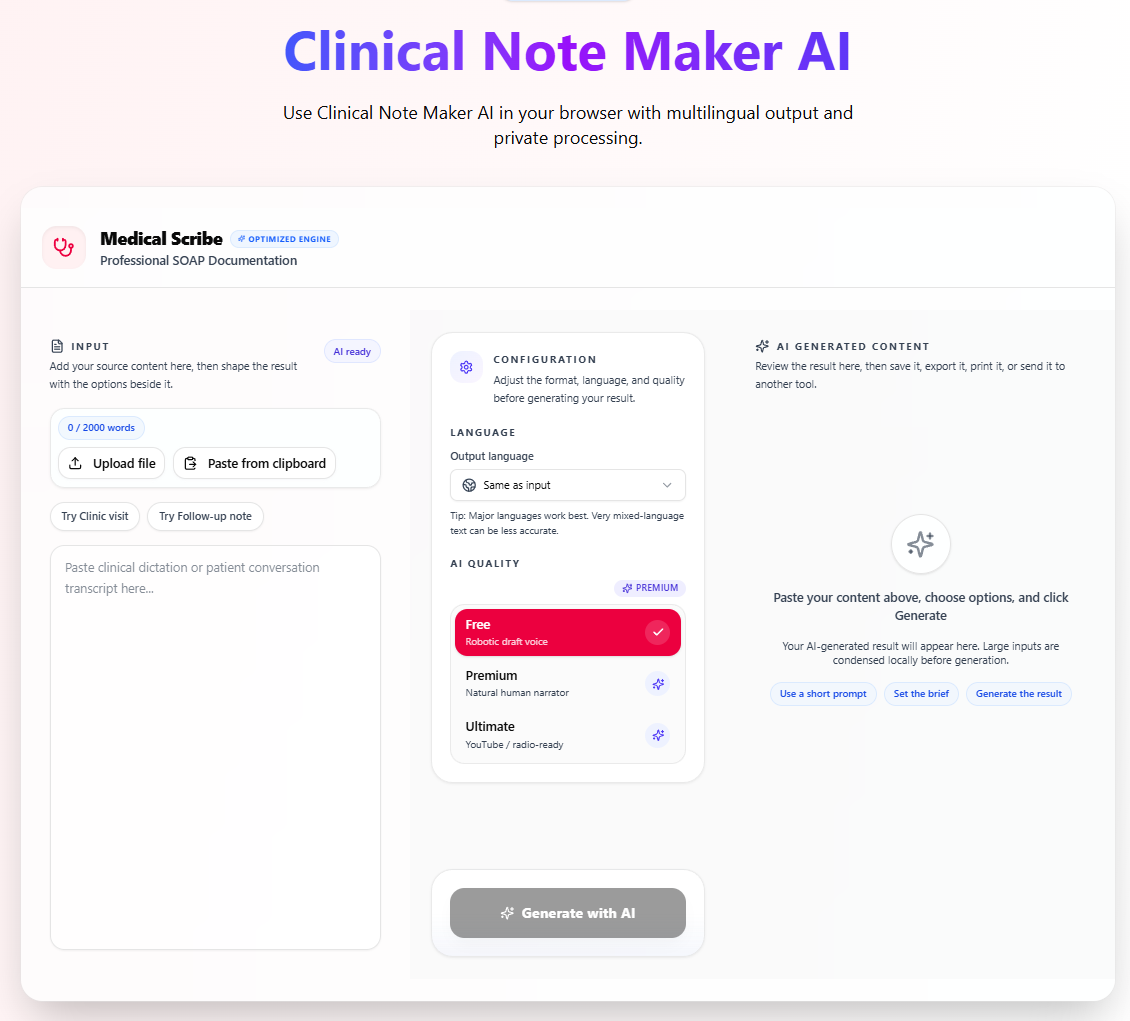
Instead of manually structuring everything from scratch after every appointment, there is now a smarter starting point. The Clinical Note Maker AI by VoiceCraftTool takes your raw patient details and turns them into a properly structured clinical note.
It does not replace your clinical judgment. It handles the structure so you can focus on the accuracy.
Key Features:
Automatic SOAP Structure
Transforms raw input into properly organized Subjective, Objective, Assessment, and Plan sections without manual formatting.
Flexible Input Options
Allows you to paste notes or upload content directly, making it simple to work with any type of clinical data.
Choose Between Speed and Detailed Output
Offers multiple quality modes so you can generate notes quickly or focus on more detailed, refined documentation.
Multilingual Support
Lets you input and generate clinical notes in different languages, making it useful across diverse healthcare settings.
Smart Extraction
Identifies symptoms, observations, assessments, and plans automatically, removing the need for manual sorting.
Reduces Documentation Time and Load
Helps streamline note-taking, saving time and easing the documentation burden that often leads to clinician burnout. Explore the tool practically and verify these useful features yourself, Clinical Note Maker AI too by VoiceCraftTool.
The AI generates a structured draft. You still need to review it before it goes anywhere official. It is a starting point, not a final product, and your clinical judgment is what makes it compliant and accurate.
How to Use Clinical Note Maker AI (Simple Steps)
Step 1) Enter Patient Information:
Paste your notes, observations, or a summary of the patient conversation directly into the tool.
Step 2) Choose Language and Quality:
Select your preferred output language and pick the mode that fits your situation, faster for routine notes, higher quality for complex cases.
Step 3) Generate the Clinical Note:
Click generate. The AI structures your input into a complete SOAP-format note within seconds.
Step 4) Review and Edit:
Read through the output. Adjust anything that does not match your clinical assessment. Always apply your own judgment before finalizing. Use it now!
How to Write Clinical Notes Manually (SOAP Method)
Even if you use AI assistance regularly, understanding the manual process makes you a better clinician and a better reviewer of AI-generated output. The SOAP format is the standard for good reason. It is logical, consistent, and easy for anyone else on the team to follow.
Step 1: Subjective
This is what the patient tells you in their own words.
Chief complaint and how long it has been going on
Symptoms described by the patient
Relevant personal or family history they mention
Step 2: Objective
This is what you directly observe or measure.
Vital signs and physical exam findings
Lab results or test data
Anything clinically observable that the patient did not self-report
Step 3: Assessment
This is your clinical interpretation of everything above.
Your diagnosis or differential diagnoses
Severity or progression of the condition
How the patient is responding to current treatment if applicable
Step 4: Plan
This is what happens next.
Medications prescribed or adjusted
Referrals, follow-ups, or tests ordered
Patient instructions or lifestyle recommendations
Using AI Alongside Manual Writing (Best Method)
You do not have to choose between writing manually and using AI. Most experienced clinicians will end up using both depending on the day.
Use AI to generate a first draft when you are short on time
Manually review and refine based on what you actually observed
Let the tool handle SOAP structure while you focus on clinical accuracy
Use it for routine documentation so your energy goes toward complex cases
Over time, reviewing AI drafts also helps you spot gaps in your own note-taking habits
Example of a Clinical Note (SOAP Format)
Subjective: Patient is a 34-year-old female presenting with a persistent dry cough for the past 10 days. She reports mild fatigue and occasional low-grade fever in the evenings. No shortness of breath. No known allergies. No recent travel.
Objective: Temperature 37.8°C. Heart rate 82 bpm. Respiratory rate 16 breaths per minute. Lungs clear on auscultation. No lymphadenopathy. Throat mildly erythematous, no exudate.
Assessment: Likely viral upper respiratory tract infection. Bacteria cause less probable given absence of productive cough and normal lung exam. Monitoring appropriate at this stage.
Plan: Supportive care advised. Increased fluid intake and rest. OTC antipyretics as needed for fever. Patients instructed to return if symptoms worsen or persist beyond 14 days. No antibiotics at this time.
Tips to Write Clinical Notes Faster and Better
Document immediately after the encounter while details are fresh
Use templates for common visit types so structure is already in place
Develop a shorthand system for phrases you use repeatedly
Focus the subjective section on the patient's exact words, not your interpretation
Keep plans specific. Vague next steps create confusion for the next clinician
If using AI, paste in your raw notes right after the appointment and refine later
Common Mistakes to Avoid:
Writing vague assessments like "patient not feeling well" without clinical detail
Mixing up subjective and objective sections
Leaving the plan section incomplete or too general
Using abbreviations that are not universally recognized
Documenting from memory hours later instead of closer to the encounter
Copying and pasting notes from previous visits without updating them
Common Use Cases
Medical students learning to structure clinical thinking in written form
Nurses documenting patient encounters and care plans
Doctors managing high patient volume with limited documentation time
Therapists and counselors who need consistent session records
Allied health professionals working in multidisciplinary teams
Conclusion
Clinical notes do not have to be the most stressful part of your day. Once you understand the SOAP structure and build a rhythm around it, the process becomes faster and more natural.
If the documentation load is still slowing you down, tools like Clinical Note Maker AI exist exactly for that reason. Use it to handle the structure, review the output with your clinical eye, and move forward with confidence.
The goal is accurate records without the burnout. You now have both the knowledge and the tools to get there. See this guide on accurate clinical notes and explore the tool, Clinical Note Maker AI tool by VoiceCraftTool.
FAQs
What are clinical notes and why are they important?
Clinical notes are written records of a patient encounter that capture what the patient reported, what you observed, your clinical assessment, and your plan for next steps. They are important because they support continuity of care, keep the whole team on the same page, and provide a legal record of your decision making and actions.
What is the SOAP format for clinical notes?
SOAP stands for Subjective, Objective, Assessment, and Plan.
Subjective: What the patient tells you such as chief complaint, symptoms, and relevant history.
Objective: What you observe or measure such as vitals, exam findings, and lab results.
Assessment: Your diagnosis or differential diagnoses and interpretation of the case.
Plan: What happens next including medications, tests, referrals, and patient instructions.
This structure is widely used because it is clear, logical, and easy for any clinician to follow quickly.
Why are many clinicians so tired of writing notes?
Documentation is time consuming, often done at the end of a busy day, and must be both accurate and legally defensible. Many clinicians end up spending more time typing than talking to patients, which contributes to burnout. AI assisted tools like Clinical Note Maker AI help by handling the structure and formatting, so you can focus on the clinical content instead of the template.
Can I use AI to write my clinical notes?
Yes, many clinicians now use AI tools to generate structured drafts of clinical notes from their raw notes or voice to text summary. The AI handles the SOAP structure and wording, but you are still responsible for reviewing, editing, and signing off on the final note. AI should support your clinical judgment, not replace it.
Are AI generated clinical notes safe and compliant?
AI generated notes are safe and compliant only if you review them carefully before finalizing. You must ensure all diagnoses, plans, and data match what actually happened in the encounter and meet your local legal and regulatory standards. Think of AI as a smart drafting assistant. It saves time, but you remain the accountable clinician.
How do I write clinical notes faster without losing quality?
You can write notes faster by:
Using a consistent SOAP template or note writing tool.
Documenting shortly after the encounter while details are fresh.
Developing a small set of clear, reusable phrases for common scenarios.
Using an AI based tool like Clinical Note Maker AI to auto structure your raw notes, then refining only what needs adjustment.
This keeps quality high while reducing repetitive typing and decision fatigue.
What are the most common mistakes in clinical notes?
Common mistakes include:
Writing vague assessments such as patients not feeling well with no clinical detail.
Mixing up subjective and objective sections.
Leaving the Plan section incomplete or too general.
Using unclear or non standard abbreviations.
Copy pasting old notes without updating them to reflect the current visit.
Regularly reviewing AI generated drafts can help you spot these patterns and improve your own documentation habits.
Who should use a tool like Clinical Note Maker AI?
Clinical Note Maker AI is useful for:
Medical students learn to structure clinical thinking in written form.Nurses and allied health professionals needing clear, consistent encounter notes.Doctors and therapists manage high patient volumes with limited time.
The tool is designed to reduce documentation load while keeping the clinician in full control of the final record.