How to Write Scroll-Stopping Social Media Hooks | Simple Method
Aug 26, 2026
8 min read
You spent time creating content. You wrote the caption, edited the video, picked the right hashtag. And still, barely anyone stopped to look. The problem is not in your content, that's a hook problem.
People scroll fast. You have maybe 2 or 3 seconds to make someone stop, and if your opening line doesn't do that job, nothing else gets seen. The good news is this is a learnable skill, and there's a simple method to get it right without spending hours testing every post.
Why Your Social Media Hooks Fail
Most people write hooks the same way they write the rest of their caption. That's the mistake. Hooks have one job, and one job only: stop the scroll. Here's why they usually don't:
Too generic: If it sounds like something anyone could have seen, people keep moving
No curiosity gap: There's nothing pulling the reader forward, no reason to stay
Takes too long to land: Three lines in and the point still hasn't arrived
Doesn't speak to the audience: It's about the creator, not the reader's pain or goal
Feels like bait: Overpromising without delivering kills trust fast
The Simple Manual Method to Write Hooks
You don't need a complicated formula. You need a clear process.
Interrupt the Scroll
Your first words have to break the pattern. A bold statement, a surprising claim, something the reader didn't expect to see. Challenge a common belief or say something that makes people think "wait, what?"
Create a Curiosity Gap
Give them a reason to keep reading. There should be a gap between what they know and what you're about to reveal. Curiosity is one of the strongest attention drivers, and a good hook makes people feel like they'd be missing out if they scrolled away.
Target a Specific Pain or Desire
Generic hooks get generic results. Speak directly to what your audience is struggling with or wants to achieve. The more specific you are, the more they feel like you're talking to them personally.
Keep It Short and Clear
A hook is not a paragraph. It should land in seconds. Cut anything that slows the reader down before they even get to your content.
Types of Hooks That Actually Work
Curiosity Hooks
Hint at something valuable without giving it away. These hooks create a gap that makes people want to keep reading. Example: “Most people don’t know this about Instagram reach…”
Bold or Contrarian Hooks
Challenge what people already believe. This grabs attention because it disrupts expectations. For example: “Posting more is actually hurting your growth.”
Question Hooks
Ask something your audience is already thinking. This creates instant connection and makes them pause.
“Why does your content get ignored even when it’s good?” such a hook will make a user feel like you are direct to the user and they may have some answer for it in their minds.
Problem Solution Hooks
Start by highlighting a clear problem, then hint that a solution is coming. This builds interest quickly. Example: “Struggling to get views? It starts with your first line.”
Relatable Hooks
Make the reader feel understood. When people see themselves in your content, they are more likely to engage. For Example: “You spent hours on that post and got 12 likes.”
Each of these works because they tap into emotion, curiosity, or the reader’s self interest. Pick the type that fits your content and your audience.
Make It Easier with Social Hook Generator AI Tool
You can write hooks manually. But it takes time, testing, and a lot of failed attempts before you land on something that actually works. And when you're creating content regularly, that adds up fast.
Most creators need multiple hook variations for the same post just to figure out which one performs. That process gets exhausting.
Key Features:
1) Strong Impression
The tool is designed around one goal, helping you grab attention immediately. Instead of weak openings, you get hooks that are built to stop the scroll and make people actually notice your content.
2) Multiple Variations
You do not have to rely on a single idea anymore. The tool gives you different hook styles in one click, so you can choose what fits your content or test a few options to see what performs better.
3) Proven Engagement Psychology
Behind the scenes, it uses patterns like curiosity gaps and attention triggers. These are the same ideas you see in content that keeps people watching longer without feeling forced.
4) Works With Your Existing Content
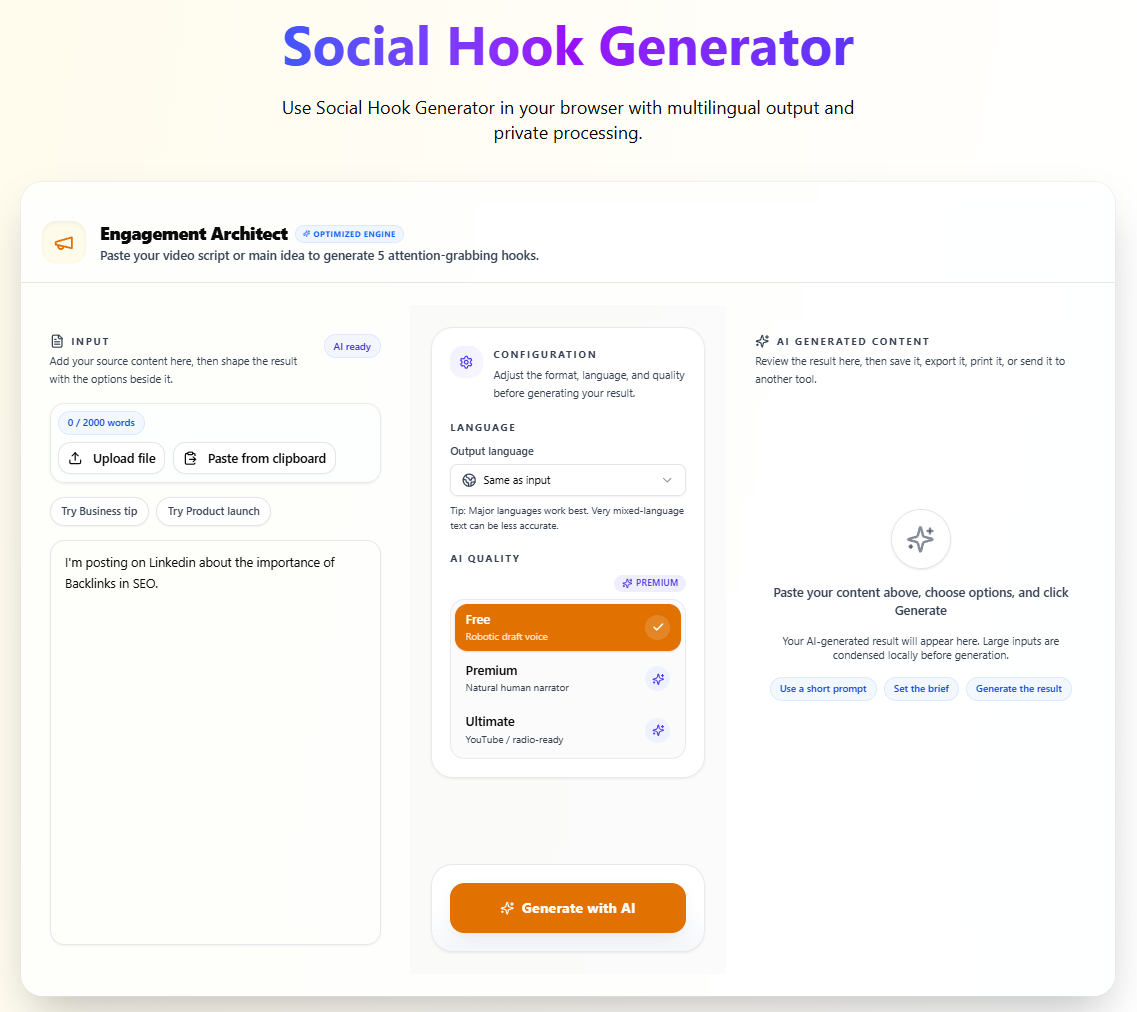
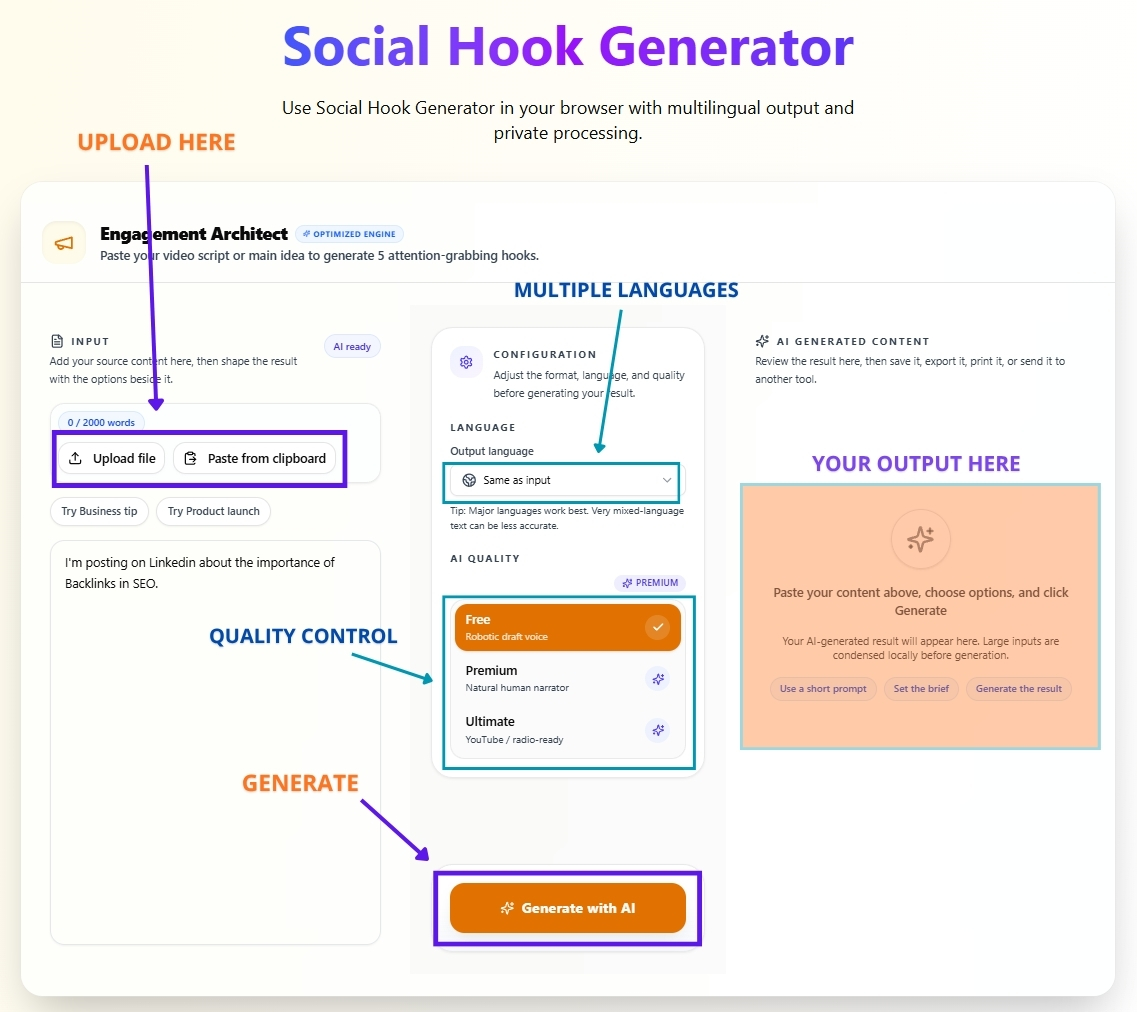
Already have a script or rough idea? Just paste it in. The tool takes what you have and turns it into stronger opening lines, so you are not starting from zero every time.
5) Multilingual Support
You can create hooks in one language and generate them in another, making it easier to reach different audiences without rewriting everything manually.
6) Simplicity and Ease
There is no setup or complicated process. You enter your idea, generate hooks, and pick the one you like. It is quick enough to use even when you are posting daily.
Small changes make a noticeable difference. Try these:
Add a specific number instead of a vague word ("5 mistakes" lands better than "some mistakes")
Keep it under 10 words when you can
Use "you" to make it feel personal
Write at least 3 hook versions per post and test them
Lead with your strongest word, not a filler like "So" or "Well"
Common Mistakes to Avoid
Writing the hook last: Treating the hook as an afterthought often leads to weak openings. The first line deserves the most attention, not the least.
Copying someone else’s hook without adapting it: What works for one audience may not work for yours. Hooks need to match your tone, niche, and the people you are trying to reach.
Overpromising and underdelivering: If the hook builds hype but the content does not deliver, you lose trust. Strong hooks should attract attention and stay honest.
Writing for yourself instead of your reader: Hooks should focus on what the audience cares about, not what you want to say. Shift the perspective to their problems and interests.
Using the same hook structure every time: Repetition makes your content predictable. Mixing different hook styles keeps your posts fresh and engaging.
Conclusion
Social media hooks decide whether your content gets seen or ignored. When you focus on clear, short, and curiosity-driven openings, your chances of stopping the scroll increase instantly.
Use a simple method, test different variations, and make the process easier with the right tools. With consistency, writing strong hooks becomes a skill you can rely on for every post.
Also check this guide for content creators if you want to make your workflow better, GUIDE FOR CONTENT CREATORS
FAQs
What is a social media hook and why does it matter?
A hook is your post's first line that stops fast scrollers in 2 to 3 seconds. Without it, even great content gets skipped. It acts as the gatekeeper to views.
How long should a hook be?
5 to 10 words works best. Short and punchy lines land instantly. Cut extra words to fit fast-moving platforms like TikTok or Instagram.
What are the best hook types that actually work?
Curiosity "Most don’t know this reach hack...", bold "Posting more hurts growth", questions "Why zero views on good content?", problem solution "Struggling with likes? Fix line 1", or relatable "Hours editing, 12 likes?"
How do I create a curiosity gap?
Tease something valuable without revealing everything. For example, "The Instagram mistake costing you 80 percent reach..." It pulls readers forward because they want the missing piece.
What is the best hook generator tool?
VoiceCraftTool Social Hook Generator lets you paste your idea and get multiple hook variations quickly using proven patterns. It adapts to platforms, supports multiple languages, and requires no setup.
Why do my hooks fail and get no engagement?
They are often too generic, not focused on the reader, or take too long to get to the point. Focus on audience pain, test a few variations, and start with strong words instead of filler.
Did you find this helpful?
Share this article with your friends and colleagues.